An introduction to medical literature, including a system of practical nosology : intended as a guide to students, and an assistant to practitioners. Together with detached essays, on the study of physic, on classification, on chemical affinities, on animal chemistry, on the blood, on the medical effects of climates, on the circulation, and on palpitation / by Thomas Young.
- Date:
- 1823
Licence: Public Domain Mark
Credit: An introduction to medical literature, including a system of practical nosology : intended as a guide to students, and an assistant to practitioners. Together with detached essays, on the study of physic, on classification, on chemical affinities, on animal chemistry, on the blood, on the medical effects of climates, on the circulation, and on palpitation / by Thomas Young. Source: Wellcome Collection.
Provider: This material has been provided by the Royal College of Physicians of Edinburgh. The original may be consulted at the Royal College of Physicians of Edinburgh.
595/700 page 561
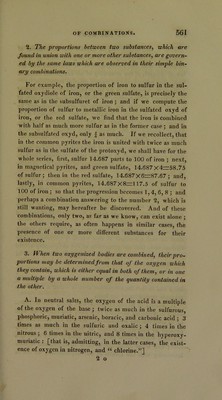
![2. The proportions between two substances, which are found in union with one or more other substances, are govern- ed by the same laws which are observed in their simple bin- ary combinations. For example, the proportion of iron to sulfur in the sul- fated oxydiole of iron, or the green sulfate, is precisely the same as in the subsulfuret of iron ; and. if we compute the proportion of sulfur to metallic iron in the sulfated oxyd of iron, or the red sulfate, we find that the iron is combined with half as much more sulfur as in the former case; and in the subsulfated oxyd, only | as much. If we recollect, that in the common pyrites the iron is united with twice as much sulfur as in the sulfate of the protoxyd, we shall have for the whole series, first, sulfur 14.687 parts to 100 of iron ; next, in magnetical pyrites, and green sulfate, 14.687X4=58.75 of sulfur; then in the red sulfate, 14.687X6=87.67; and, lastly, in common pyrites, 14.687X8=117.5 of sulfur to 100 of iron ; so that the progression becomes 1,4, 6, 8 ; and perhaps a combination answering to the number 2, which is still wanting, may hereafter be discovered. And of these combinations, only two, as far as we know, can exist alone ; the others require, as often happens in similar cases, the presence of one or more different substances for their existence. 3. When two oxygenized bodies are combined, their pro- portions may be determined from that of the oxygen which they contain, which is either equal in both of them, or in one a multiple by a whole number of the quantity contained in the other. A. In neutral salts, the oxygen of the acid is a multiple of the oxygen of the base ; twice as much in the sulfurous, phosphoric, muriatic, arsenic, boracic, and carbonic acid ; 3 times as much in the sulfuric and oxalic; 4 times in the nitrous ; 6 times in the nitric, and 8 times in the hyperoxy- muriatic : [that is, admitting, in the latter cases, the exist- ence of oxygen in nitrogen, and “ chlorine.”] 2 o](https://iiif.wellcomecollection.org/image/b21915805_0595.jp2/full/800%2C/0/default.jpg)