An introduction to medical literature, including a system of practical nosology : intended as a guide to students, and an assistant to practitioners. Together with detached essays, on the study of physic, on classification, on chemical affinities, on animal chemistry, on the blood, on the medical effects of climates, on the circulation, and on palpitation / by Thomas Young.
- Date:
- 1823
Licence: Public Domain Mark
Credit: An introduction to medical literature, including a system of practical nosology : intended as a guide to students, and an assistant to practitioners. Together with detached essays, on the study of physic, on classification, on chemical affinities, on animal chemistry, on the blood, on the medical effects of climates, on the circulation, and on palpitation / by Thomas Young. Source: Wellcome Collection.
Provider: This material has been provided by the Royal College of Physicians of Edinburgh. The original may be consulted at the Royal College of Physicians of Edinburgh.
600/700 page 566
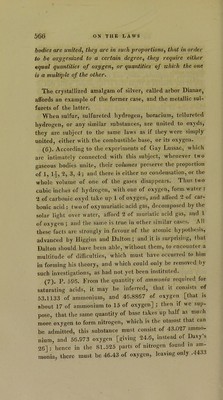
![bodies are united, they are in such proportions, t/rnt in order to be oxygenized to a certain degree, they require either equal quantities of oxygen, or quantities of which the one is a multiple of the other. The crystallized amalgam of silver, called arbor Dianae? affords an example of the former case, and the metallic sul- furets of the latter. When sulfur, sulfureted hydrogen, boracium, tellureted hydrogen, or any similar substances, are united to oxyds, they are subject to the same laws as if they were simply united, either with the combustible base, or its oxygen. (6). According to the experiments of Gay Lussac, which are intimately connected with this subject, whenever two gaseous bodies unite, their volumes preserve the proportion of 1, 1^, 2, 3, 4; and there is either no condensation, or the whole volume of one of the gases disappears. 4 hus two cubic inches of hydrogen, with one of oxygen, form water . 2 of carbonic oxyd take up 1 of oxygen, and afford 2 of cai- bonic acid : two of oxymuriatic acid gas, decomposed by the solar light over water, afford 2 of muriatic acid gas, and 1 of oxygen ; and the same is true in other similar cases. All these facts are strongly in favour of the atomic hypothesis, advanced by Higgins and Dalton; and it is surprising, that Dalton should have been able, without them, to encounter a multitude of difficulties, which must have occurred to him in forming his theory, and which could only be removed by such investigations, as had not yet been instituted. (7). P. 596. From the quantity of ammonia required for saturating acids, it may be inferred, that it consists of 53.1133 of ammonium, and 46.8867 of oxygen [that is about 17 of ammonium to 15 of oxygen] ; then if we sup- pose, that the same quantity of base takes up half as much more oxygen to form nitrogen, which is the utmost that can be admitted, this substance must consist of 43.027 ammo- nium, and 56.973 oxygen [giving 24.6, instead of Davy’s 26]: hence in the 81.525 parts of nitrogen found in am- monia, there must be 46.43 of oxygen, leaving only .4433](https://iiif.wellcomecollection.org/image/b21915805_0600.jp2/full/800%2C/0/default.jpg)