Volume 183302
England and the English / by Edward Lytton Bulwer.
- Edward Bulwer-Lytton
- Date:
- 1833
Licence: Public Domain Mark
Credit: England and the English / by Edward Lytton Bulwer. Source: Wellcome Collection.
120/370 page 104
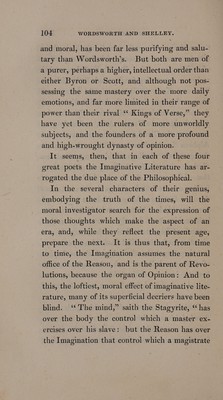
![and moral, has been far less purifying and salu- tary than Wordsworth’s. But both are men of a purer, perhaps a higher, intellectual order than either Byron or Scott, and although not pos- sessing the same mastery over the more daily emotions, and far more limited in their range of power than their rival ‘‘ Kings of Verse,” they have yet been the rulers of more unworldly subjects, and the founders of a more profound and high-wrought dynasty of opinion. It seems, then, that in each of these four great poets the Imaginative Literature has ar- rogated the due place of the Philosophical. In the several characters of their genius, embodying the truth of the times, will the moral investigator search for the expression of those thoughts which make the aspect of an era, and, while they reflect the present age, prepare the next. It is thus that, from time to time, the Imagination assumes the natural office of the Reason, and is the parent of Revo- lutions, because the organ of Opinion: And to this, the loftiest, moral effect of imaginative lite- rature, many of its superficial decriers have been blind. ‘* The mind,” saith the Stagyrite, ‘has over the body the contro] which a master ex- ercises over his slave: but the Reason has over the Imagination that control which a magistrate](https://iiif.wellcomecollection.org/image/b33029362_0002_0120.jp2/full/800%2C/0/default.jpg)