[Report 1947] / School Medical Officer of Health, Exeter.
- Exeter (England). City Council.
- Date:
- 1947
Licence: Attribution 4.0 International (CC BY 4.0)
Credit: [Report 1947] / School Medical Officer of Health, Exeter. Source: Wellcome Collection.
12/62 (page 12)
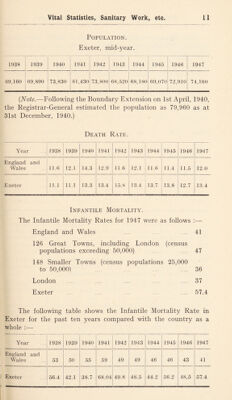
![The following composite table gives useful information regarding Child-bearing and Infancy for the past ten years :— Year. Maternal Deaths. Maternal Mortality Rate. Neonatal Deaths. Deaths under 1 year. Infantile Mortality Rate. Regis- tered Births nett. 1938 1 0.9 32 57 56.4 1,010 1939 3 3.1 24 40 42.1 936 1940 2 1.8 26 41 38.7 1,012 1941 5 4.1 42 79 68.04 1,027 1942 3 2.7 32 53 49.8 1,065 1943 3 2.8 35 51 48.5 1,051 1944 8 5.8 32 59 44.2 1,334 1945 4 3.1 33 70 56.2 1,246 1946 4 2.7 45 70 48.5 1,444 1947 4 2.7 47 82 57.4 1,428 It will be noticed that the maternal mortality rate remains • unchanged and is again attributable to four maternal deaths. But whereas there were no deaths due to sepsis in 1946, there were i two such deaths in 1947. Both these deaths were caused by ■ pulmonary embolism, one following “ white leg rather late in i the puerperium, and the other following miscarriage. One of the ji two other deaths appeared to be inevitable, and the other might ti r possibly have been avoided by better management. li It is very disappointing to have to record again an infantile -‘l mortality rate above that of the other “ great towns in the 1 Registrar-Generabs classification, and higher than that of the ! Country as a whole. It will be seen that more than half the infant ' ; deaths are neo-natal, that is to say they occurred in the first • twenty-eight days following birth. One would not expect the I work of the welfare centres to have any influence on neo-natal ] mortality. Children of this age are rarely brought to the welfare ■ . centres, and in fact, none of these infants did attend a centre, r On the other hand, ante-natal care, social conditions and the i habits of the mother may exert considerable influence. Actually, i no less than 32 of these 47 infants failed to survive a week, and i : 37 of the 47 deaths were ascribed to prematurity and congenital t defects. An examination of the infant death enquiry cards does m not reveal any particular cause such as overcrowding or un- c](https://iiif.wellcomecollection.org/image/b29199256_0014.jp2/full/800%2C/0/default.jpg)