The travels of Ibn Batuta : translated from the abridged Arabic manuscript copies, preserved in the Public Library of Cambridge. with notes, illustrative of the history, geography, botany, antiquities, &c. occurring throughout the work / translated with notes by S. Lee, [and, Report of the proceedings of the first general meeting of the subscribers to the Oriental Translation Fund].
- Ibn Batuta, 1304-1377.
- Date:
- 1829
Licence: Public Domain Mark
Credit: The travels of Ibn Batuta : translated from the abridged Arabic manuscript copies, preserved in the Public Library of Cambridge. with notes, illustrative of the history, geography, botany, antiquities, &c. occurring throughout the work / translated with notes by S. Lee, [and, Report of the proceedings of the first general meeting of the subscribers to the Oriental Translation Fund]. Source: Wellcome Collection.
Provider: This material has been provided by Royal College of Physicians, London. The original may be consulted at Royal College of Physicians, London.
283/294 page 11
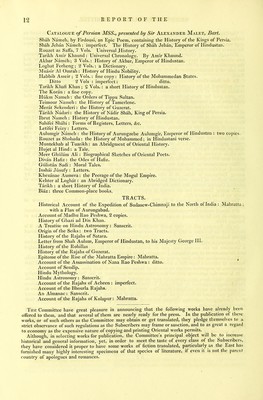
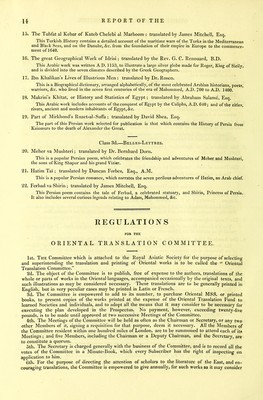
![]J The Committee hope that the latitude they have proposed for themselves will only be considered an evidence of their extensive hopes and views, and that the Subscribers, in giving these regulations their sanction, will leave the Committee unshackled, at least for the first year, that they may have the means of ascertaining their power to accomplish the objects for which they were appointed. Although most of these regulations have been formed on the basis of the original Prospectus, two alterations have been suggested, which it is thought will add considerably to the usefulness and the pecuniary means of the Society :—these are, the creation of a second class of subscribers, and the sale of a certain number of each of the works printed at the expense of the Oriental Translation Fund. As the Subscribers of Ten guineas each are entitled gratuitously to a fine-paper copy of every work published by the Committee, it is proposed that an annual subscriber of five guineas shall be entitled to any of the works published by tbe Committee, to the extent of his subscription, at half the price paid for them by the public; but without having his name printed on the title-page, that distinction being reserved for the first class of Subscribers. In relation to the second proposal, it is calculated that the difference of expense between an edition of 250 and of 500 copies of any book is only about 7 per cent, exclusive of paper : printing the latter number instead of the former, and selling the copies that remain on hand after the Subscribers are furnished with those to which they are entitled, will therefore defray a considerable part of the expense of printing any translation, and thus enable the Committee to print additional works. The following particulars are added, to shew the advantage of printing some copies for sale of such works as the Committee may publish. An edition of 250 copies of a Persian and English work of 450 octavo pages would cost £125, or 10s. per copy; but the second 250 copies might be obtained for £35. or about 2s. lOd. per copy. If the second 250 copies were gradually sold at only 10s. each, the whole expense of printing the work would be ultimately repaid, with the exception of £35, for which sum 250 copies would be obtained by the Subscribers. This calculation is founded on the supposition that none but really interesting works will be printed, and that there will consequently be a demand for them in England, on the Continent, and among Europeans in Asia. It is also confidently expected that many copies will be bought by learned natives of India, who may be either desirous of learning English or of possessing texts of standard Oriental works, free from the errors which often abound in manuscript copies. The acting Treasurer has the honour to report to the Subscribers the state of the Society’s funds, made up to the present day. The amount of subscriptions is £1,128. 15s., from which is to be deducted the expense of printing and circulating the Prospectus and incidental charges. If it should receive the approbation of the Subscribers, the annual subscriptions will be considered payable on the 1st of January in each year, the second subscription being reckoned due on the 1st of January 1829. As the Secretary will be very much occupied in transacting the business of the Committee, it is hoped that the payment of fifty pounds a year to him, from the 1st of January 1828, will be approved by the Subscribers. In connexion with the finances, it only remains for the Subscribers to elect from among themselves a Treasurer for the ensuing year, and an Auditor, to report at the next annual meeting the receipts and disbursements of the Oriental Translation Fund for the year that will then terminate. The Committee, after thus giving an account of their proceedings and of the state of their funds, venture to express a hope that a continuation and increase of support will enable them to extend their operations, in proportion as their views enlarge in the execution of their plan. It is now the agreeable duty of the Committee to announce to the Subscribers the encouraging prospects which have been created by their munificent support. The prosperous state of their funds, the advantages presented by tbe English Universities and the Royal Asiatic Society, and the gratuitous aid tendered by many eminent Orientalists, warrants the belief that the Subscribers, in addition to enjoying the honour of fostering an important branch of learning, and rescuing the national character from the charge of neglecting Oriental literature, will annually receive books greatly exceeding their subscriptions in value. The Committee are desirous to avoid attributing too much effect to their labours; but they feel bound to state, that they know that the circulation of their Prospectus has already stimulated some individuals to undertake translations of Oriental works, and has attracted much attention to Asiatic literature. The inquiries of the Committee have already brought to light several translations which had long remained unnoticed, and they have received a valuable collection of Oriental MSS. which were col- lected by the late Sir Charles Malet, Bart, during his residence in India, and presented to them by his son. Sir Alexander Malet, Bart., as soon as he was informed of their establishment and objects. A Catalogue of this collection is annexed. B 2](https://iiif.wellcomecollection.org/image/b28406084_0287.jp2/full/800%2C/0/default.jpg)


 No text description is available for this image
 No text description is available for this image
 No text description is available for this image