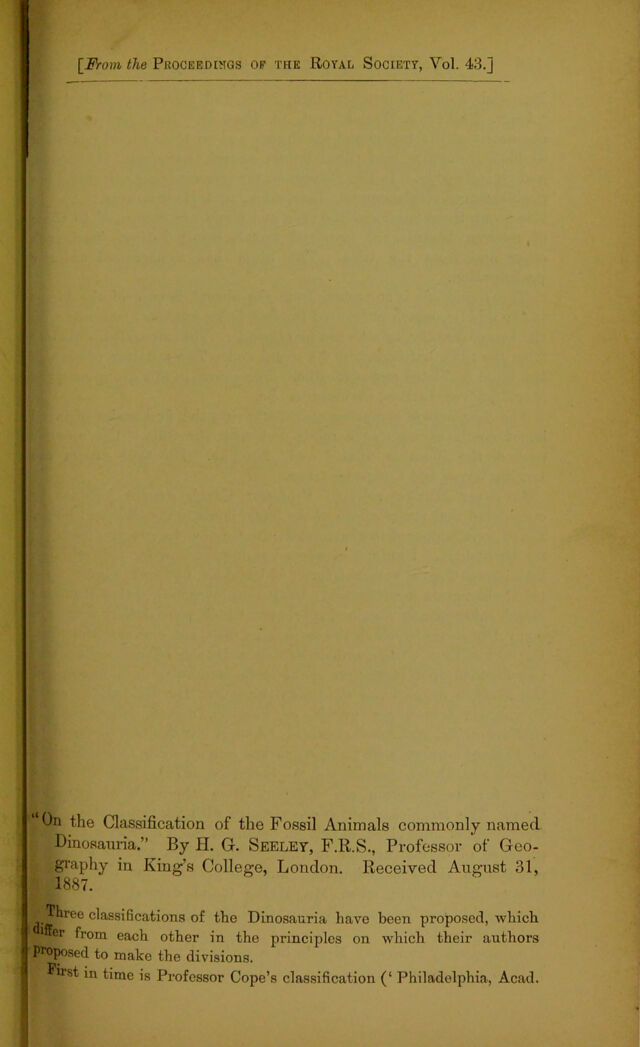
On the classification of the fossil animals commonly named Dinosauria / by H.G. Seeley.
- Harry Govier Seeley
- Date:
- 1887
Licence: Public Domain Mark
Credit: On the classification of the fossil animals commonly named Dinosauria / by H.G. Seeley. Source: Wellcome Collection.
Provider: This material has been provided by The Royal College of Surgeons of England. The original may be consulted at The Royal College of Surgeons of England.
9/10 page 171
![ami the other limb is directed forward. Neither of these limbs of the pubis appears to form a median symphysis. The ilium is prolonged in front of the acetabulum as a more or less slender process or bar. The vertebroo are solid, and the skeleton is not pneumatic. The basi-cranial structure is distinctive, differing from that of Crocodiles and Lizards. The body and limbs are frequently covered with scutes which may form a complete shield or be reduced so as to be unrecognis- able. The digits vary from three to five. Saurischia. In this order the pubis is directed forward from its symphysis with the ischium, and no posterior limb of the bone is developed. Both pubis and ischium appear to meet by a median symphysis, so that the arrangement and relations of the bones ai*e Lacertilian. The anterior prolongation of the ilium has a vertical expansion. The vertebras are more or less pneumatic or cavernous; and in the dorsal region the neural arch is commonly elevated. The basi-cranial structure is sub- lacertilian. No armour has been found. The digits vary in number from three to five. I see no ground for associating these two orders in one group, unless that group includes Birds, Crocodiles, Anomodonts, and Orni- thosaurs; for differences of pelvic structure have been as persistently inherited as any condition of the vertebrate skeleton. The classification may be summarised in the following table :— Cope, 1866. Huxley, 1870. Seeley, 1874. Marsh, 1878-84. Cope, 1883. Seeley, 1887. Orders. Families. Order. Orders. Orders. Orders. Orthopoda ... f Scelidosauridae t Iguanodontidiu Stegosauria ... Ornithopoda... ] Orthopoda Ornithischia. Cetiosauria... Sauropoda ... Opisthocoela* ... Goniopoda .. Symphopoda Megalosauridse Compsognatha ... ] Theropoda ... Goniopoda Hallopoda. j Saurischia. * Sir Richard Owen grouped Cetiosaurus and Streptospondylus in an extinct sub-order of Crocodiiia named Opistlioccela in 1859 ; while Megalosaurus and Iguanodon were united to form the Dinosauria in 1841. This is the earliest and most definite reference of these animals to separate ordinal groups. BABBISON and sons, pbintbbs in obdinaey to heb majesty, st. maetin’s lane.](https://iiif.wellcomecollection.org/image/b22412542_0011.jp2/full/800%2C/0/default.jpg)


 No text description is available for this image
 No text description is available for this image
 No text description is available for this image