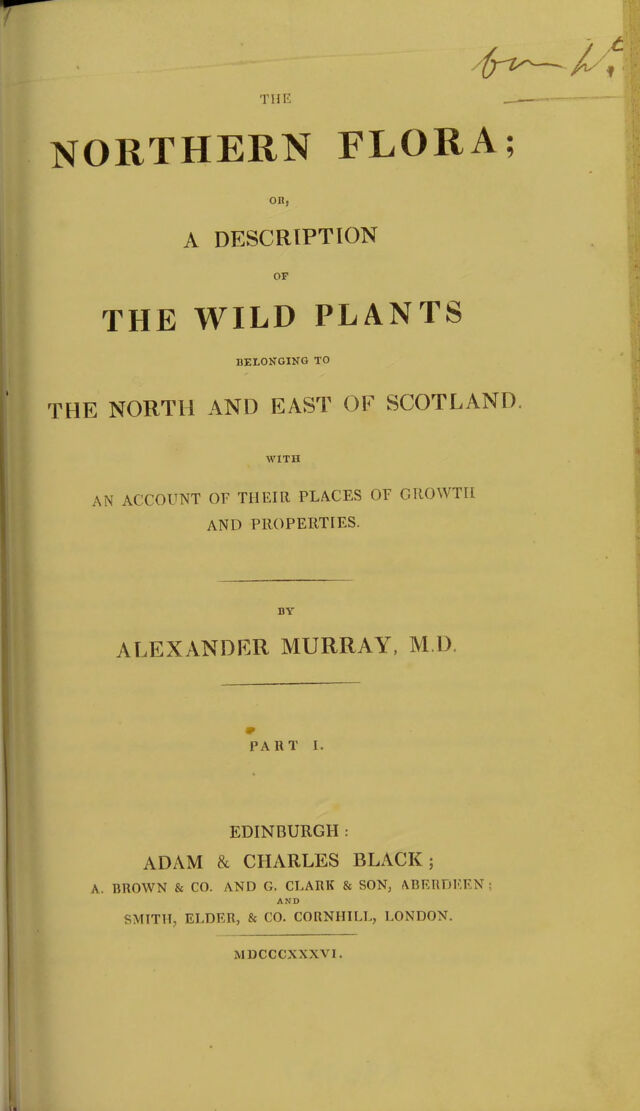
The northern flora, or, A description of the wild plants belonging to the north and east of Scotland, with an account of their places of growth and properties. Part. 1 / by Alexander Murray.
- Date:
- 1836
Licence: Public Domain Mark
Credit: The northern flora, or, A description of the wild plants belonging to the north and east of Scotland, with an account of their places of growth and properties. Part. 1 / by Alexander Murray. Source: Wellcome Collection.
Provider: This material has been provided by the Royal College of Physicians of Edinburgh. The original may be consulted at the Royal College of Physicians of Edinburgh.
159/194 page 141
![PKNTAXDRIA. ] degree its useful qualities, without causing the bad effects, fairly attributed to that medicine. There can, however, be no doubt, that in large doses, Hyoscyamus is a decided poison. Dr. Christison, in his work on Poisons, (2d Edi- tion, 648) observes, In a treatise on vegetable poisons, Mr. Wilmer has related the history of six persons in a family, who were poisoned by eating, at dinner, the roots of the Hyoscyamus by mistake instead of parsneps. Several were delirious and danced about the room like maniacs, one appeared as if he had got drunk, and a woman became pro- foundly and irrecoverably comatose. Emetics could not be introduced into the stomach, stimulant clysters had no effect, external stimuli of every kind failed to rouse, and she expired next morning at six. The roots, in this instance, were gathered in the winter time—a fact which does not quite coincide with the conclusions to be drawn from Or- fila's experiments, that the plant must be in full vegetation, before its energy, as a poison, is considerable. GENUS XXI. ATROPA. Calyx inferior, of one leaf, with five segments. Co- rolla bell-shaped ; its lobes five, nearly equal. Sta- mens distant. Anthers heart-shaped. Berry glo- bular, two-celled, placed in the enlarged permanent calyx. SPECIES. I. Atro^Q. Belladonna. Dwale. Deadly Night-shade. Root fleshy, creeping. Stem herbaceous, erect, two or three feet high. Leaves often in twos, ovate, pointed, en- tire, unequal, and upon short stalks. Flowers purple, soli- tary, drooping, stalked. Berry black and shining, sur- rounded by the calyx. Rare ; and scarcely indigenous. In Bonnington Den, near Maryton, two miles south from Montrose. Dr. Balfour.—Kialoss Abbey, in Moray. Mr. W. A. Stables. Perennial—flowering in June. Obs.—Whole plant fetid when bruised, of a dark and lurid aspect, mdicative of its deadly narcotic quality. * * Berry, the size of a small cherry, sweetish, and not nauseous, so that children have often been tempted to eat it to their own destruction.—^SwiM The terra Belladonna signifies a beautiful woman in the Italian lan- guage, and was given to this plant in consequence of the ladies using Its berry in the composition of a paint for the face. Upon one occasion, as many as 150 soldiers were poisoned, ■](https://iiif.wellcomecollection.org/image/b21942973_0161.jp2/full/800%2C/0/default.jpg)