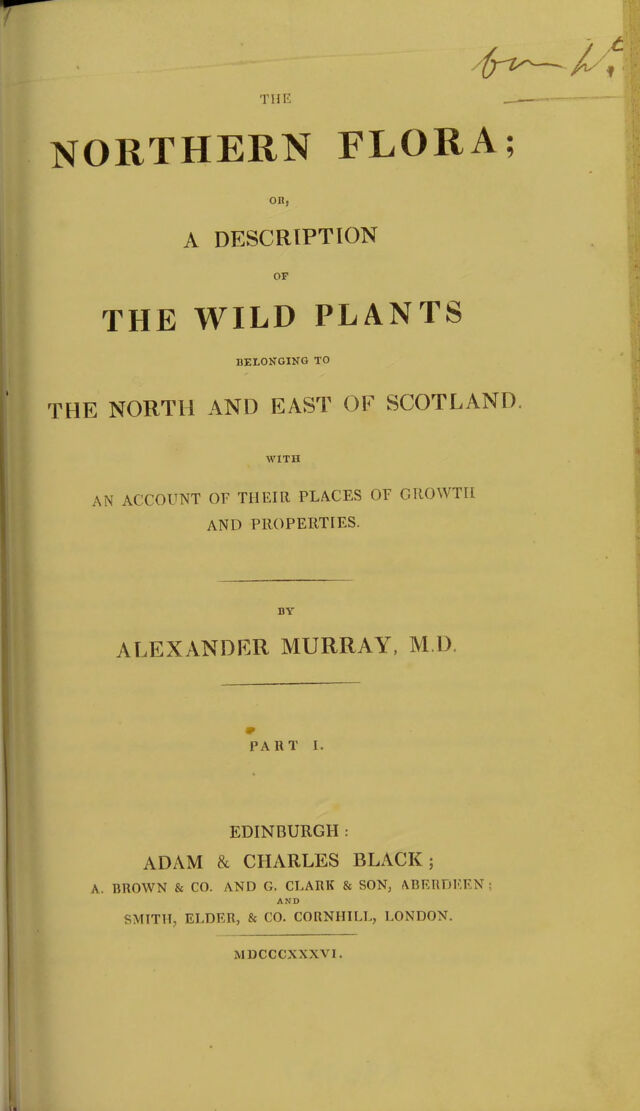
The northern flora, or, A description of the wild plants belonging to the north and east of Scotland, with an account of their places of growth and properties. Part. 1 / by Alexander Murray.
- Date:
- 1836
Licence: Public Domain Mark
Credit: The northern flora, or, A description of the wild plants belonging to the north and east of Scotland, with an account of their places of growth and properties. Part. 1 / by Alexander Murray. Source: Wellcome Collection.
Provider: This material has been provided by the Royal College of Physicians of Edinburgh. The original may be consulted at the Royal College of Physicians of Edinburgh.
165/194 page 147
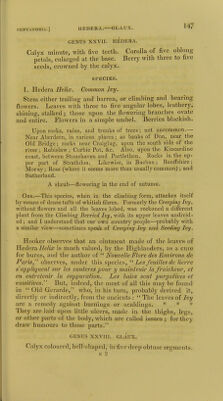
![I'EKTANDRIA. J IlEDERA. —GLAUX. GENUS XXVII. HEDERA. Calyx minute, with five teeth. Corolla of five oblong petals, enlarged at the base. Berry with three to five seeds, crowned by the calyx. SrECIES. 1. Hedera Helix. Common Ivy. Stem either trailing and barren, or clim])ing and bearing flowers. Leaves with three to five angular lobes, leathery, shining, stalked; those upon the flowering branches ovate and entire. Flowers in a simple umbel. Berries blackish. Upon rocks, ruins, and trunks of trees; not uncommon.— Near Aberdeen, in various places; as banks of Don, near the Old Bridge; rocks near Craiglug, upon the south side of the river; Rubislaw ; Corbie Pot, &c. Also, upon the Kincardine coast, between Stonehaven and Portlethen. Rocks in the up- per part of Strathdon. Likewise, in Buchan; Banffshire; Moray; Ross (where it seems more than usually common) ; and Sutherland. A shrub—flowering in the end of autumn. Obs.—This species, when in the climbing form, attaches itself by means of dense tufts of whitish fibres. Formerly the Creeping Ivy, without flowers and all the leaves lobed, was reckoned a different plant from the Climbing Berried Ivy, with its upper leaves undivid- ed ; and I understand that our own country people—probably with a similar view—sometimes speak of Creeping Ivy and Seeding Ivy. Hooker observes that an ointment made of the leaves of Hedera//e/w? is much valued, by the Highlanders, as a cure for burns, and the author of Nouvelle Flore des Environs de Paris, observes, under this species, Les feuilles de lierre s'appliqucnt sur les cauteres pour y mainienir la J'raicheur, et en entreienir la siqjpuration. Les baies sont purgatives et vomitives. But, indeed, the most of all this may be found in Old Gerarde, who, in his turn, probably derived it, directly or indirectly, from the ancients .: The leaves of Ivy are a remedy against burnings or scaldings. * * * They are laid upon little ulcers, made in the thighs, legs, or other parts of the body, which are called issues ^ for they <lraw humours to those parts. GENUS XXVIII. GLAUX. Calyx coloured, bell-shaped, in five deep obtuse segments. K 2](https://iiif.wellcomecollection.org/image/b21942973_0167.jp2/full/800%2C/0/default.jpg)