On the presence of a glycolytic enzyme in muscle / by Sir T. Lauder Brunton and Herbert Rhodes.
- Brunton, Thomas Lauder, Sir, 1844-1916.
- Date:
- 1901
Licence: In copyright
Credit: On the presence of a glycolytic enzyme in muscle / by Sir T. Lauder Brunton and Herbert Rhodes. Source: Wellcome Collection.
Provider: This material has been provided by The Royal College of Surgeons of England. The original may be consulted at The Royal College of Surgeons of England.
3/11
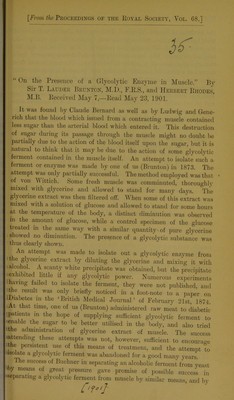
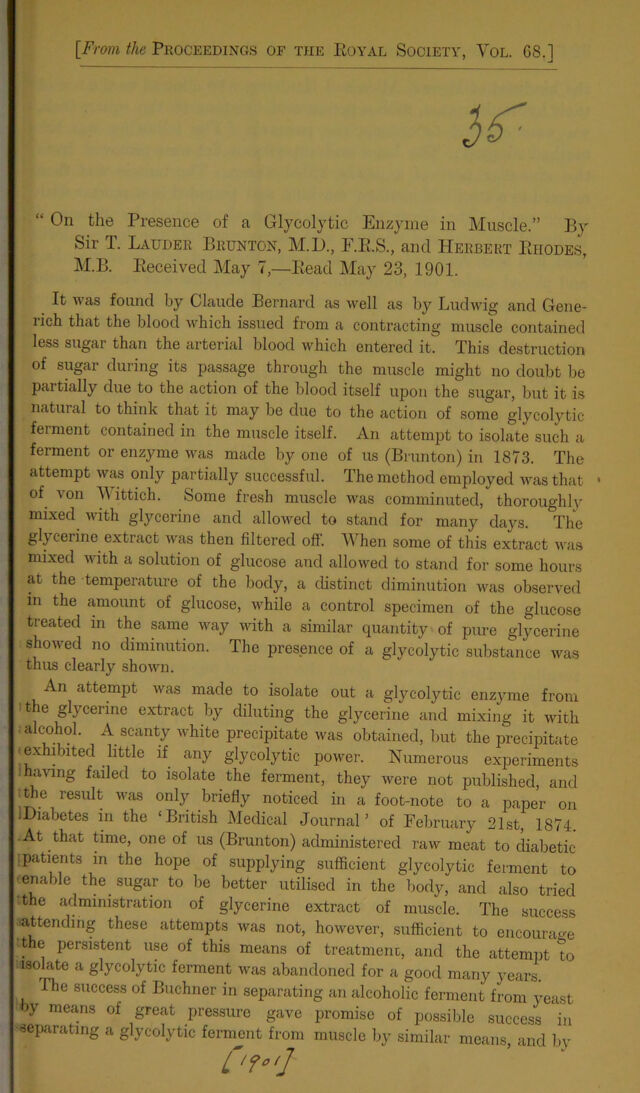
![[From the Proceedings of the Eoyal Society, Vol. 68.] “ On the Presence of a Glycolytic Enzyme in Muscle.” By Sir T. Lauder Brunton, M.D., F.E.S., and Herbert Erodes, M.B. Eeceivecl May 7,—Eeacl May 23, 1901. ^ It was found by Claude Bernard as well as by Ludwig and Gene- rich that the blood which issued from a contracting muscle contained less sugar than the arterial blood which entered it. This destruction of sugar during its passage through the muscle might no doubt be partially due to the action of the blood itself upon the sugar, but it is natural to think that it may be due to the action of some glycolytic ferment contained in the muscle itself. An attempt to isolate such a ferment or enzyme was made by one of us (Brunton) in 1873. The attempt was only partially successful. The method employed was that of von Mittich. Some fresh muscle was comminuted, thoroughly mixed with glycerine and allowed to stand for many days. The glycerine extract was then filtered off. When some of this extract was mixed with a solution of glucose and allowed to stand for some hours at the temperature of the body, a distinct diminution was observed in the amount of glucose, while a control specimen of the glucose treated in the same way vdth a similar quantity'of pure glycerine showed no diminution. The presence of a glycolytic substance was thus clearly shown. An attempt was made to isolate out a glycolytic enzyme from I the glycerine extract by diluting the glycerine and mixing it with jalc-ohol. A scanty white precipitate was obtained, but the precipitate (exhibited little if any glycolytic power. Numerous experiments 1 having failed to isolate the ferment, they were not published, and t^e result was only briefly noticed in a foot-note to a paper on IDiabetes in the ‘British Medical Journal’ of February 21st, 1874. •At that time, one of us (Brunton) administered raw meat to diabetic {patients in the hope of supplying sufficient glycolytic ferment to eenable the sugar to be better utilised in the body, and also tried tthe administration of glycerine extract of muscle. The success ^attending these attempts was not, however, sufficient to encourage tthe persistent use of this means of treatment, and the attempt to isolate a glycolytic ferment was abandoned for a good many years. The success of Buchner in separating an alcoholic ferment from yeast by means of great pressure gave promise of possible success in •separating a glycolytic ferment from muscle by similar means and bv /'f-7](https://iiif.wellcomecollection.org/image/b22430003_0003.jp2/full/800%2C/0/default.jpg)