[Report 1937] / Medical Officer of Health, West Lancashire R.D.C.
- West Lancashire (England). Rural District Council.
- Date:
- 1937
Licence: Attribution 4.0 International (CC BY 4.0)
Credit: [Report 1937] / Medical Officer of Health, West Lancashire R.D.C. Source: Wellcome Collection.
128/146 page 116
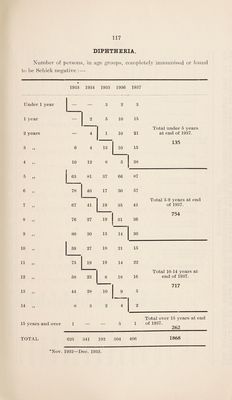
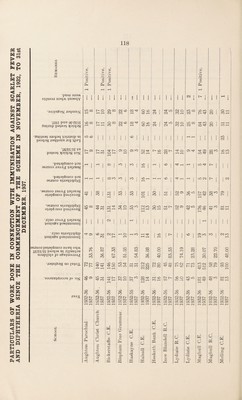
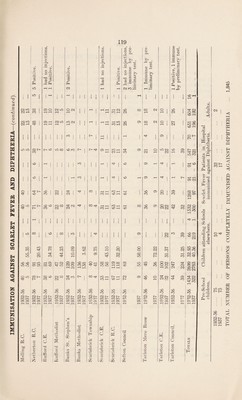
![sufficiently strong to persuade such people to “ be wise in time ” by having the injection done when the disease is not prevalent. At the close of a recent outbreak, one mother wrote, I think the injection seems to upset him foi a day or two, so do yoo think it is necessary now, as everything seems quiet? ” With the apparent passing of the danger, the zeal for protection was gone. Here again the period of school life would a])pear to' be the period of greatest danger. “ Carriers are healthy persons, who although they have not contracted' the disease, harbour the bacilli in their throats and are able tO’ disseminate' the disease tO' O'thers. It has been shown by some workers that while protecting the children whoi have been injected, the tendency of an immunisation scheme is to increase rather than to diminish the number of carriers. Hence, though the scheme may protect the school children it may yet increase the danger tO' 'unprotected children of below school age. A rapid fall in the incidence of diphtheria can only be looked for when both groups of children have been protected. The proportion of immunised children must be maintained at over thirty per cent. Since the inception of the scheme no case of di})htheria has occurred in a child who has received three injections and passed the final skin test. In the few children who' have contracted scarlet, fever after having been immunised, the disease was so attenuated that the rash was barelv discernible and the children not ill at all. Parents are encouraged to attend at the school if they so desire, and it is gratifying toi note the steady increase in the number of parents who do attend, and the interest taken in the scheme by the public generally. The manv institutions in the district which receive children into ty their homes would do well tO' require a dipjhtheria immunisation certificate fromi each child. Experience has proved that the treatment is rather popular than otherwise. There is a definite advantage in holding the clinic in a large schoolroom; with many children present the children are confident, cheerful and take an interest in what is going on. On the other hand, one session in a small room of sufficient size tO' accommodate three only at a time proved a failure. The attached table demonstrates the work done from the inception of the scheme in November, 1932 to the end of 1937. It will be noticed from a ])erusal of the table that practically 100 ])er cent, of the children Schick tested were proved to be insusceptible to diphtheria three months after their final injection. The figure is particularly gratifying and clearly proves the efficiency of diphtheria prophylaxis.](https://iiif.wellcomecollection.org/image/b30261636_0128.jp2/full/800%2C/0/default.jpg)