Diseases of poultry in New South Wales / T.G. Hungerford.
- New South Wales. Department of Agriculture
- Date:
- 1939
Licence: In copyright
Credit: Diseases of poultry in New South Wales / T.G. Hungerford. Source: Wellcome Collection.
14/248
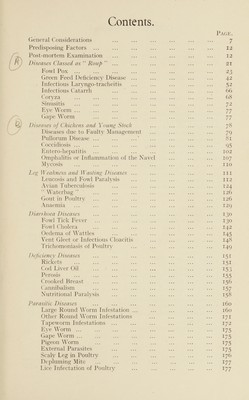
![Wostry of Agricumure, Fisbertes and Feed, “Veterinary Lehorasory . ad We. imtsvaatosta aoe Author’s Preface auth. mtcnnattic. Aeages Metz es] 2a : : ; Wis oiccectene Tris book is not written as a technical treatise on poultry diseases, but comprises a statement of the diseases of poultry which cause most economic loss in this State, together with a popular account of symp- toms, control measures, as well as an indication of what is still unknown concerning some of the disease conditions. Neither is the book written as a veterinary text-book, but is designed for those connected with the industry, who, by virtue of interest or necessity, desire to make a care- ful study of poultry diseases. Those who have only a passing interest in disease may find that the amount of detail given is somewhat irksome. This has been done intentionally, as a passing interest which leads one to make an ill-founded diagnosis and to carry out incorrect treatment will usually demonstrate that “a little knowledge is a dangerous thing.” Whilst this book does not go into scientific detail, it is pointed out that the diagnosis of poultry disease has, by modern scientific methods, been brought to a degree of accuracy comparable with that of other branches of veterinary science and of human medicine, and, with the advent of qualified veterinarians into poultry practice, the poultry farmer now has available the advice of specialists to assist him in dealing with his disease problems. Above all, it is desired to point out that the information in this book must be considered conjointly with information concerning housing, management and feeding, as the subjects of disease and management are inseparably interrelated. For such information, the reader is referred to “Poultry Farming in New South Wales,” issued by the Department of Agriculture. Scientific information concerning diseases of poultry is making such vast advances that, without doubt, by the time this book is published it will already be partly out of date. The most recent information on new advances might be sought from a practising veterinary surgeon or from the Chief Veterinary Surgeon of the Department of Agriculture. Diseases are grouped not as to cause, which would perhaps be the most logical arrangement, but according to the symptoms present, Thus all conditions which produce “roup” are grouped. This method has been adopted, because a farmer whose birds are showing such well- known symptoms will want to know of all the diseases which may cause such symptoms. The convenience of this grouping, it is felt, over-rules the annovance which must be experienced by a veterinarian who finds, for instance, in the “roup” diseases, a disease such as avitaminosis A (a food deficiency disease) grouped with laryngo-tracheitis (a virus disease). Home remedies have been listed for most diseases, not because they are of value (usually they have no value). but because farmers will use something, and it is perhaps best to mention remedies which for the most part are harmless, so that they may be employed by the poultry keeper to satisfy his urge to “do something.”](https://iiif.wellcomecollection.org/image/b32174585_0014.jp2/full/800%2C/0/default.jpg)



 No text description is available for this image
 No text description is available for this image
 No text description is available for this image