A manual of surgery for students and practitioners / by William Rose and Albert Carless.
- William Rose
- Date:
- 1900
Licence: Public Domain Mark
Credit: A manual of surgery for students and practitioners / by William Rose and Albert Carless. Source: Wellcome Collection.
31/1254 (page 13)
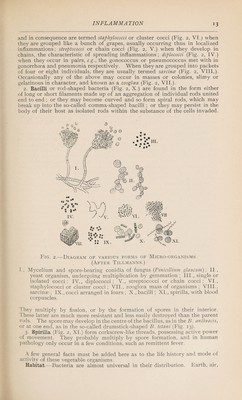
![]3 and in consequence are termed staphylococci or cluster cocci (Fig. 2, VI.) when they are grouped like a bunch of grapes, usually occurring thus in localized inflammations; streptococci or chain cocci (Fig. 2, V.) when they develop in chains, the characteristic of spreading inflammations; diplococci (Fig. 2, IV.) when they occur in pairs, e.g., the gonococcus or pneumococcus met with in gonorrhoea and pneumonia respectively. When they are grouped into packets of four or eight individuals, they are usually termed sarcince (Fig. 2, VIII.). Occasionally any of the above may occur in masses or colonies, slimy or gelatinous in character, and known as a zooglcea (Fig. 2, VII.). 2. Bacilli or rod-shaped bacteria (Fig. 2, X.) are found in the form either of long or short filaments made up of an aggregation of individual rods united end to end ; or they may become curved and so form spiral rods, which may break up into the so-called comma-shaped bacilli ; or they may persist in the body of their host as isolated rods within the substance of the cells invaded. Fig. 2.—Diagram of various forms of Micro-organisms (After Tillmanns.) I., Mycelium and spore-bearing conidia of fungus {Penicillium glaucum); II., yeast organism, undergoing multiplication by gemmation ; III., single or isolated cocci; IV., diplococci; V., streptococci or chain cocci; VI., staphylococci or cluster cocci; VII., zoogloea mass of organisms ; VIII., sarcinae ; IX., cocci arranged in fours ; X., bacilli; XI., spirilla, with blood corpuscles. They multiply by fission, or by the formation of spores in their interior. These latter are much more resistant and less easily destroyed than the parent rods. The spore may develop in the centre of the bacillus, as in the B. anthracis, or at one end, as in the so-called drumstick-shaped B. tetani (Fig. 13). 3. Spirilla (Fig. 2, XI.) form corkscrew-like threads, possessing active power of movement. They probably multiply by spore formation, and in human pathology only occur in a few conditions, such as remittent fever. A few general facts must be added here as to the life history and mode of activity of these vegetable organisms. Habitat.—Bacteria are almost universal in their distribution. Earth, air,](https://iiif.wellcomecollection.org/image/b31356473_0031.jp2/full/800%2C/0/default.jpg)