The optimum temperature of salicin hydrolysis by enzyme action is independent of the concentrations of substrate and enzyme / by Arthur Compton.
- Compton, Arthur.
- Date:
- [1914?]
Licence: Public Domain Mark
Credit: The optimum temperature of salicin hydrolysis by enzyme action is independent of the concentrations of substrate and enzyme / by Arthur Compton. Source: Wellcome Collection.
3/14
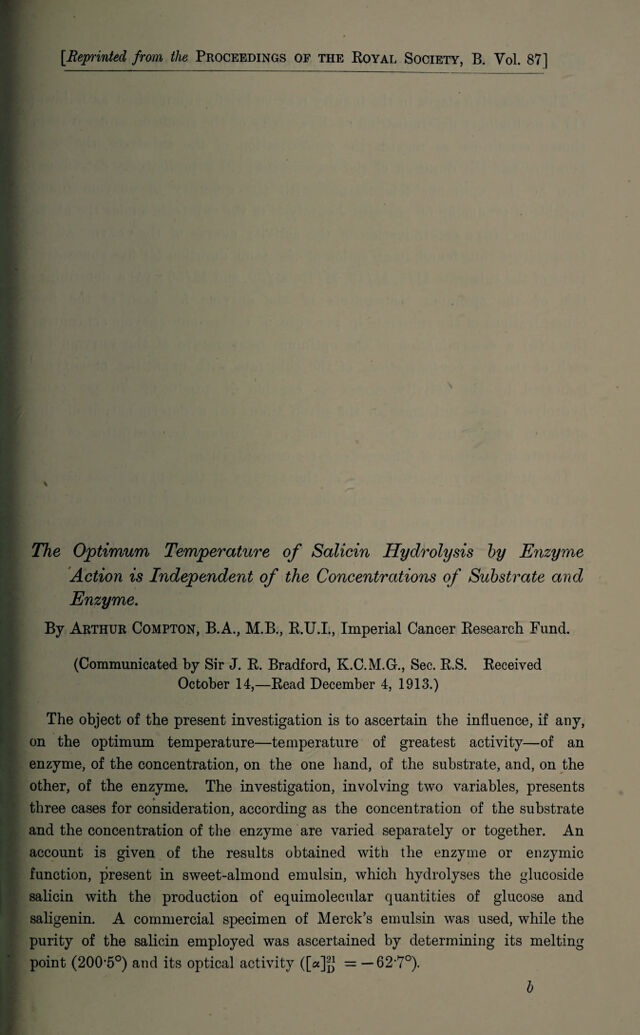
![The Optimum Temperature of Salicin Hydrolysis by Enzyme Action is Independent of the Concentrations of Substrate and Enzyme. By Arthur Compton, B.A., M.B., R.U.I., Imperial Cancer Research Fund. ■ (Communicated by Sir J. R. Bradford, K.C.M.G., Sec. R.S. Received October 14,—Read December 4, 1913.) The object of the present investigation is to ascertain the influence, if any, on the optimum temperature—temperature of greatest activity—of an enzyme, of the concentration, on the one hand, of the substrate, and, on the other, of the enzyme. The investigation, involving two variables, presents three cases for consideration, according as the concentration of the substrate and the concentration of the enzyme are varied separately or together. An account is given of the results obtained with the enzyme or enzymic function, present in sweet-almond emulsin, which hydrolyses the glucoside salicin with the production of equimolecular quantities of glucose and saligenin. A commercial specimen of Merck’s emulsin was used, while the purity of the salicin employed was ascertained by determining its melting point (200-5°) and its optical activity ([a]g = — 62*7°). ■ b](https://iiif.wellcomecollection.org/image/b30620971_0003.jp2/full/800%2C/0/default.jpg)