Lateral curvature of the spine and round shoulders / by Robert W. Lovett.
- Robert W. Lovett
- Date:
- 1912
Licence: Public Domain Mark
Credit: Lateral curvature of the spine and round shoulders / by Robert W. Lovett. Source: Wellcome Collection.
Provider: This material has been provided by the Francis A. Countway Library of Medicine, through the Medical Heritage Library. The original may be consulted at the Francis A. Countway Library of Medicine, Harvard Medical School.
194/214 (page 176)
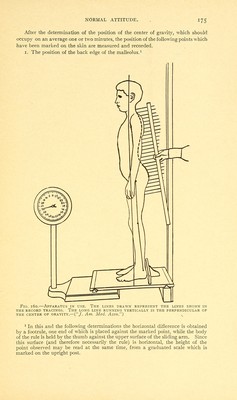
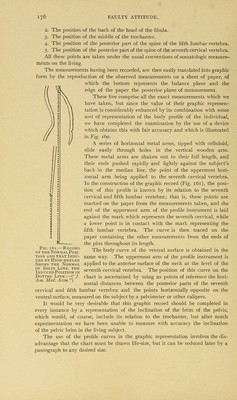
![2. The position of the back of the head of the fibula. 3. The position of the middle of the trochanter. 4. The position of the posterior part of the spine of the fifth lumbar vertebra. 5. The position of the posterior part of the spine of the seventh cervical vertebra. All these points are taken under the usual conventions of somatologic measure- ments on the living. The measurements having been recorded, are then easily translated into graphic form by the reproduction of the observed measurements on a sheet of paper, of which the bottom represents the balance plane and the edge of the paper the posterior plane of measurement. These five comprise all the exact measurements which we have taken, but since the value of their graphic represen- tation is considerably enhanced by its combination with some sort of representation of the body profile of the individual, we have completed the examination by the use of a device which obtains this with fair accuracy and which is illustrated in Fig. 160. A series of horizontal metal arms, tipped with celluloid, slide easily through holes in the vertical wooden arm. These metal arms are shaken out to their full length, and their ends pushed rapidly and lightly against the subject's back in the median line, the point of the uppermost hori- zontal arm being applied to the seventh cervical vertebra. In the construction of the graphic record (Fig. 161), the posi- tion of this profile is known by its relation to the seventh cervical and fifth lumbar vertebrae; that is, these points are marked on the paper from the measurements taken, and the end of the uppermost arm of the profile instrument is laid against the mark which represents the seventh cervical, while a lower point is in contact with the mark representing the fifth lumbar vertebra. The curve is then traced on the paper containing the other measurements from the ends of the pins throughout its length. of TH^NoRMAifposi0 ^e body curve of the ventral surface is obtained in the tion and that Indu- same way. The uppermost arm of the profile instrument is ced by High-heeled ,. , , . , ,. , , , , , ,. , Shoes the Normal applied to the antenor surface of the neck at the level of the iNDu^DPosmbNiN sevent]l cervical vertebra. The position of this curve on the Dotted Line.—(/. chart is ascertained by using as points of reference the hori- Am. Med. Assn. ) , ,. . , . . . zontal distances between the posterior parts of the seventh cervical and fifth lumbar vertebras and the points horizontally opposite on the ventral surface, measured on the subject by a pelvimeter or other calipers. It would be very desirable that this graphic record should be completed in every instance by a representation of the inclination of the brim of the pelvis, which would, of course, include its relation to the trochanter, but after much experimentation we have been unable to measure with accuracy the inclination of the pelvic brim in the living subject. The use of the profile curves in the graphic representation involves the dis- advantage that the chart must be drawn life-size, but it can be reduced later by a pantograph to any desired size.](https://iiif.wellcomecollection.org/image/b21172006_0194.jp2/full/800%2C/0/default.jpg)