The reduction of hydroxylaminodihydroumbelluloneoxime / by Frank Tutin.
- Tutin, Frank.
- Date:
- 1907
Licence: In copyright
Credit: The reduction of hydroxylaminodihydroumbelluloneoxime / by Frank Tutin. Source: Wellcome Collection.
Provider: This material has been provided by The Royal College of Surgeons of England. The original may be consulted at The Royal College of Surgeons of England.
5/8 page 277
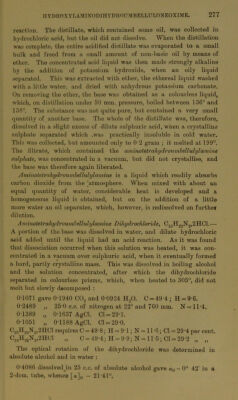
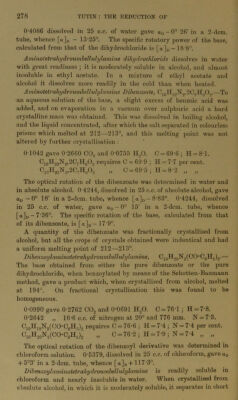
![reaction. The distillate, which contained some oil, was collected in hydrochloric acid, but the oil did not dissolve. When the distillation was complete, the entire acidified distillate was evaporated to a small bulk and freed from a small amount of non-basic oil by means of ether. The concentrated acid liquid was then made strongly alkaline by the addition of potassium hydroxide, when an oily liquid separated. This was extracted with ether, the ethereal liquid washed with a little water, and dried with anhydrous potassium carbonate. On removing the ether, the base was obtained as a colourless liquid, which, on distillation under 50 mm. pressure, boiled between 136° and 138°. The substance was not quite pure, but contained a very small quantity of another ba.se. The whole of the distillate was, therefore, dissolved in a slight excess of dilute sulphuric acid, when a crystalline sulphate separated which .was practically insoluble in cold water. This was collected, but amounted only to 0'2 gram ; it melted at 199°. The filtrate, which contained the aminotetrahydrouinbellulylamine sulphate, was concentrated in a vacuum, but did not crystallise, and the base was therefore again liberated. Aminotelrahydroumbellulylamine is a liquid which readily absorbs carbon dioxide from the [atmosphere. When mixed with about an equal quantity of water, considerable heat is developed and a homogeneous liquid is obtained, but on the addition of a little more water an oil separates, which, however, is redissolved on furthei dilution. Aminotelrahydroumbellulylamine Dihydrochloride, Cjq 1122^2,21101.— A portion of the base was dissolved in water, and dilute hydrochloric acid added until the liquid had an .acid reaction. As it was found that dissociation occurred when this solution was heated, it was con- centrated in a vacuum over sulphuric acid, when it eventually formed a hard, partly crystalline mass. This was dissolved in boiling alcohol and the solution concentrated, after which the dihydrochloride separated in colourless prisms, which, when heated to 305°, did not melt but slowly decomposed : 0-1071 gave 0-1940 COg and 0-0924 HgO. C = 49-4; H = 9-6. 0-2489 „ 25-0 c.c. of nitrogen at 22° and 760 mm. N=ll-4. 0-1389 „ 0-1637 AgCl. Cl = 29-1. 0-1051 „ 0-1188 AgCl. Cl = 29-0. CioH2oN2,2HC1 requires C = 49-8; H = 9-1 ] N = 11-6 j Cl = 29*4 per cent. CioH22N2,2HC1 „ C = 49-4jH = 9-9;N = ll-5; 01 = 29-2 „ „ The optical rotation of the dihydrochloride was determined in absolute alcohol and in water : 0-4086 dissolvedJn 25 c.c. of absolute alcohol gave - 0° 42' in a, 2-dcm. tube, whence [aj^ - 21-41°,](https://iiif.wellcomecollection.org/image/b22425366_0007.jp2/full/800%2C/0/default.jpg)