Mr John Spear's report to the local government board upon the so-called "Woolsorters' Disease" as observed at Bradford and in neighbouring districts in the west Riding of Yorkshire.
- Spear, John.
- Date:
- 1881
Licence: Public Domain Mark
Credit: Mr John Spear's report to the local government board upon the so-called "Woolsorters' Disease" as observed at Bradford and in neighbouring districts in the west Riding of Yorkshire. Source: Wellcome Collection.
Provider: This material has been provided by London School of Hygiene & Tropical Medicine Library & Archives Service. The original may be consulted at London School of Hygiene & Tropical Medicine Library & Archives Service.
46/70 (page 46)
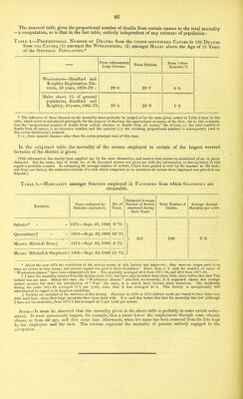
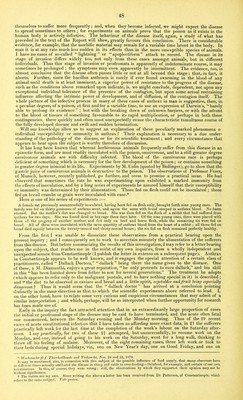
![The annexed table gives the proportional number of deaths from certain causes to the total mortality —a computation, as is that in the last table, entirely independent of any estimate of population: Table 4.—Proportional Number of Deaths from the under-mentioned Causes to 100 Deaths from all Causes, (1) amongst the Woolsorters, (2) amongst Males above the Age of 15 Years of the General Population.* — From inflammatory Lung Diseases. From Phthisis. From “other Zymotics.”f W oolsorters—Bradford and Keighley Registration Dis- tricts, 10 years, 1870-79 - 28-0 20-7 4'6 Males above 15 of general population, Bradford and Keighley, 10 years, 1861-70 18-4 20-9 1-8 * The influence of these diseases on the mortality must probably be judged of by the rates given rather in Table 2 than in this table, which latter is introduced principally for the purpose of showing the approximate accuracy of the first; for in this computa- tion the “ proportional number of deaths from certain diseases to deaths from all causes,” the divisor, i.e. the total number of deaths from all causes, is an excessive number, and the quotient {i.e. the resulting proportional number) is consequently (and to this extent factitiously) reduced. f i.e., from zymotic diseases other than the seven principal ones of this class. In the subjoined table the mortality of the sorters employed in certain of the largest worsted factories of the district is given. [This information has mostly been supplied me by the men themselves, and must to that extent be considered of an ex parte character. But the name, date of death, &c. of the deceased person was given me with this information, so that accuracy in this regard is probably assured. In estimating the average number of sorters, I have been guided as well by the masters as the men ; and from one factory the numerical records of a club which comprised as its members all sorters there employed was placed at my disposal.] Table 5.—Mortality amongst Sorters employed in Factories from which Statistics are obtainable. Factories. Years embraced by Statistics (inclusive). No. of Years. Estimated Average Number of Sorters employed during these Years. Total Number of Deaths. Average Annual Mortality per 1,000. Saltaire* 1871—Sept. 30, 1880 9-75 Queensburyf 1864—Sept. 30,1880 16-75 v 4^ Cn 106 3-6 Messrs. Mitchell Bros.J 1874—Sept. 30, 1880 6-75 Messrs. Mitchell & Shepherd’s 1869—Sept. 30,1880 11-75 J * About the year 1876 the ventilation of the sorting rooms at this factory was improved ; they were no longer used to so large an extent as store rooms, and greater regard was paid to their cleanliness. Since then, it is said, the number of cases of “ Woolsorters disease” have been comparatively few. The mortality averaged 26 6 from 1871-76, and 20'0 from 1877-80. f I have the mortality returns from this factory since 1851, but have only included those since 1864, since before that date Yan mohair was not used. Before this time the “ Woolsorters disease ” attacked occasionally, it is supposed, alpaca and average mohair sorters, but since the introduction of “ Van ” the cases, it is stated, have become more numerous. The death-rate during the years 1851-63 averaged 17'3 per 1,000, since then it has averaged 21'2. This factory is exceptionally well administered in regard to its hygienic conditions. + Backers are included in the statistics of this factory. Previous to 1873 or 1874 inferior wools are stated to have been very little used here ; since then large quantities have been dealt with. It is said thac before that date the mortality was low (although I have not the statistics), from 1874 it has averaged 28• 5 per 1,000 per annum. Note. It must be observed that the mortality given in the above table is probably to some extent under- stated. It must occasionally happen, for example, that a sorter leaves the employment through some chronic illness, or from old age, and dies some time afterwards, when his name has been removed from the lists kept by the employers and the men. The returns represent the mortality of persons actively engaged in the occupation,](https://iiif.wellcomecollection.org/image/b24996774_0048.jp2/full/800%2C/0/default.jpg)