First and second reports from the Select Committee on Medical Registration and Medical Law Amendment : together with the minutes of evidence and appendix.
- Great Britain. Parliament. House of Commons. Select Committee on Medical Registration and Medical Law Amendment.
- Date:
- 1848
Licence: Public Domain Mark
Credit: First and second reports from the Select Committee on Medical Registration and Medical Law Amendment : together with the minutes of evidence and appendix. Source: Wellcome Collection.
Provider: This material has been provided by Royal College of Physicians, London. The original may be consulted at Royal College of Physicians, London.
13/146 page 9
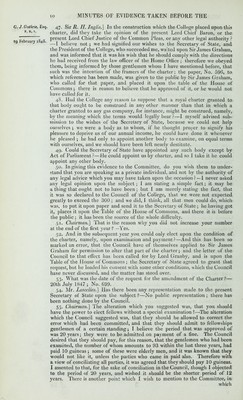
![31. The new charter allowed you to name 300 without examination?—Yes, G. J. Guthrie, Esq. and without payment. f. r. s. 32. Was that the whole number allowed to be named ?—It was first 250, which was subsequently changed to 300 within the first three months. 2y Iebruai7 ,848* 33. When the charter was passed, you were allowed to name 300, who were to be fellows without payment and without examination, their nomination to take place within three months ?—Yes. 34. Did the charter allow you to name any number of fellows you pleased after that?—Yes, within the year. 35. Upon payment ?—No, still without payment; to make up for any omissions that might be found to have taken place in the first 300 ; after the year, every body must pay and be examined. The second list contained 242 names. 36. But there was no limit to the number you might elect paying and being examined ?—No. 37. During even the first year there was no limitation as to the number you might have elected fellows without payment or examination, was there?—The limitation was the implication which I have endeavoured to explain. 38. Apart from that implication, there is no limit in the charter?—No, only we were informed that it was not our duty greatly to exceed 300. 39. But the charter did not make the limit?—No; but the framers of the charter did. 40. Mr. French.~\ In making this selection of your original 300, were not the Council of the College in the habit of inquiring into and forming some opinion as to the professional merits of the practitioners they so selected ? — The Council of the College of Surgeons know nothing of the 10,000 men belonging to them, except such persons as they happen individually to know ; but they did not know one quarter of the men who claimed to be made Fellows; therefore, as they did not know them, so as to judge of their merits, many were left out who deserved the honour. 41. The charter authorizes the College “ with all convenient speed after the date of these our letters patent, and before the expiration of three calendar months, to elect as fellows out of their number, a number not less than 250, nor more than 300, and that by one general diploma ”?—That was done. 42. Then it provides in the fourth clause, that “ it shall also be lawful for the Council of the College, at any time or times after the expiration of three calendar months, and before the expiration of one year from the date thereof, by diploma or diplomas under the seal of the College, with such forms as the Council shall see fit, and without any fee, to appoint any other person or persons to be fellow or fellows of the Royal College of Surgeons of England there- fore it is absolutely without limit; then it goes on, that with respect to the election of members to be fellows after the expiration of that year, it should be done by the grant of a diploma after examination, and upon payment of the fees; how many did you make the first year?—I have said 300, and afterward 242. 43. Altogether, how many did you make the first year ?—Five hundred and forty-two. 44. Why did you limit your election to 542 ?—Because the gentlemen who were the private advisers of Sir James Graham informed the Council that it was not the intention of the framers of the charter that we should make more than 300, or at least that the Council should greatly exceed that number; as I mentioned before, the Council did not know who were the framers of the charter, except Sir James Graham, and the law officer of the College; the consequence of that was, that nearly all above that number of 300 were made with considerable difficulty, in consequence of its being considered to be in opposition to the wish of the Secretary of State ; and as we had submitted ourselves to his will, a great part of the Council thought it right to do exactly as they believed he desired to have done. 45. Mr. Lascelles.] Had not the Council the power within themselves of reme- dying- this grievance, if they had chosen to exercise it ?—If they had thought it right to do it, under the circumstances stated. 46. Mr. French.] Had you anv official communication from the Secretary of State to say that he wished the number to be limited ?—No, only the expression of his supposed intention by those whom the Council knew to be in his con- fidence. 210. B 47. Sir](https://iiif.wellcomecollection.org/image/b24906773_0015.jp2/full/800%2C/0/default.jpg)



 No text description is available for this image
 No text description is available for this image
 No text description is available for this image