First and second reports from the Select Committee on Medical Registration and Medical Law Amendment : together with the minutes of evidence and appendix.
- Great Britain. Parliament. House of Commons. Select Committee on Medical Registration and Medical Law Amendment.
- Date:
- 1848
Licence: Public Domain Mark
Credit: First and second reports from the Select Committee on Medical Registration and Medical Law Amendment : together with the minutes of evidence and appendix. Source: Wellcome Collection.
Provider: This material has been provided by Royal College of Physicians, London. The original may be consulted at Royal College of Physicians, London.
16/146 page 12
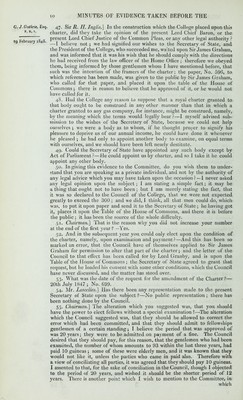
![G.J. Guthrie, Esq. should not practise pharmacy?—Yes, and that and other exclusions have made r. r. s. many practitioners so angry, that they have asked for a college of their own. 66. You have kept that bye-law?—Yes. 29 February 1848. 67. None of your members are eligible to be fellows if they are practitioners of pharmacy, or if they are living beyond five miles from London ?—No; nor in midwifery. 68. With the exception of surgeons in country hospitals ?—They cannot suc- ceed to the honours of the College, because they do not live in London. 69. Colonel Mure.'] There was nothing in the charter, irrespective of the bye-law, which precluded you from choosing the 300 fellows out of the more eligible members of the profession, was there ; you might have passed a resolu- tion to elect the whole of the 300 out of the more eligible qualified members under the new charter ?—It was distinctly understood that we were not to do so ; we could not do it under the bye-law of 1745 still in force. 70. Chairman.] Is there any thing in the new charter to prevent your revising that bye-law, and altering it with respect to practitioners in pharmacy and persons resident beyond seven miles of London?—We might have revised the bye-law, but they are excluded by the charter. To conclude my remarks on the officers of the public service, I will beg leave to say, that the matter has ended by their being placed upon the list of fellows in five different ways. The cavalry of the Guard are placed upon it in one way, the infantry of the Guard in another way, the infantry of the Line in a third, the navy in a fourth, and the East India Company’s service in a fifth ; so that there is no uniform rule in regard to either one or other of these services. The head of the navy insisted upon doing as he pleased ; the College yielded; he had his own way, and he made an officer of the year 1841 a fellow, excluding officers 30 years older, merely to prove his right, which caused the greatest confusion among them, and the greatest degree of dissatisfaction. The next point which gave the officers of the public service great offence was this: when we had made our first 300, and there was no person who was an apothecary who was not an hospital surgeon also, or a “ servant,” among them, it was thought right, in this first list, to include a certain number of apothecaries to conciliate them, 17. Instead, however, of that gratifying them, as we did not take the seniors, but selected from among them certain individuals, whom we knew to be excellent and good men, the consequence was they were more angry than before. To have 17 selected out of 10,000 to be placed upon the list as a compliment, was what they did not understand, and they were very angry. But the armv and navy were also very angry, because all those officers of 40 years’ standing, some of them the most distinguished officers in the service, were ousted by those 17 surgeon apothecaries. They had a right, as I have pointed out, to stand before them, but these gentlemen could not be placed, from their number, upon the list, by the Council, but by placing those 17 surgeon apothecaries above them, it conferred a rank upon those 17 gentlemen practising pharmacy, of which they, the surgeons, had been actually deprived. 71. Being simply members of the College, and not fellows, they had the mortification of seeing those 17 gentlemen placed above them, and were thus deprived of those rights and privileges which they had enjoyed for 100 years. The charter not only did that, but, at the same time, it deprived the Surgeon- general of the army and the Serjeant-surgeons of their right of sitting on the Council tx officio, and in so doing, removed the person they had a right to look to in the Council. The only other thing I shall allude to as one of the matters which materially affect the officers of the public service, and which deserves some little consideration, is a distinction in regard to the making of fellows which is very invidious, and which, I think, certainly should be altered. It is a bye-law, and has been approved by the Secretary of State as all bye-laws are; in fact, no bye-laws can be made unless they receive his sanction. It is the bye-law I alluded to as illiberal, and which, I have no doubt, if it were explained to Sir James Graham, he would withdraw his own sanction from. This bye-law provides, that a gentleman, being a Bachelor of Arts of either of the English Universities, shall, ipso facfo, be entitled, with a proper education of four years, to be a fellow of the College of Surgeons, after examination ; but if he happens not to be a Bachelor of Arts, if he happens to be a Wrangler, if he happens to be a Chancellor’s Medalist, and has not been able, in con- sequence of his religion—in consequence of his being a Catholic or a Presbyterian,](https://iiif.wellcomecollection.org/image/b24906773_0018.jp2/full/800%2C/0/default.jpg)



 No text description is available for this image
 No text description is available for this image
 No text description is available for this image