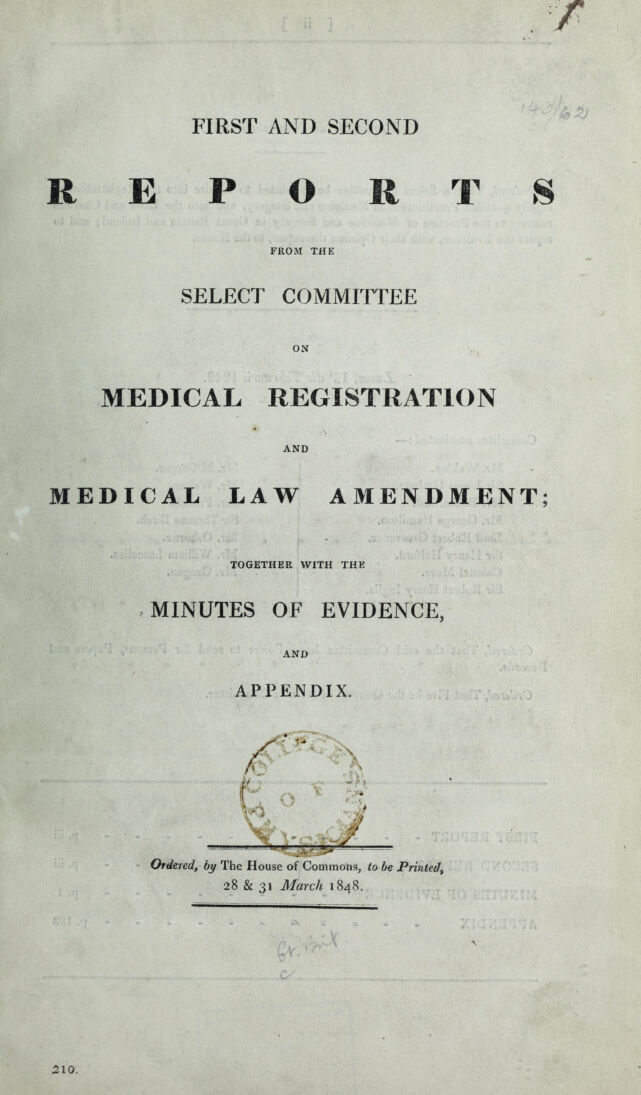
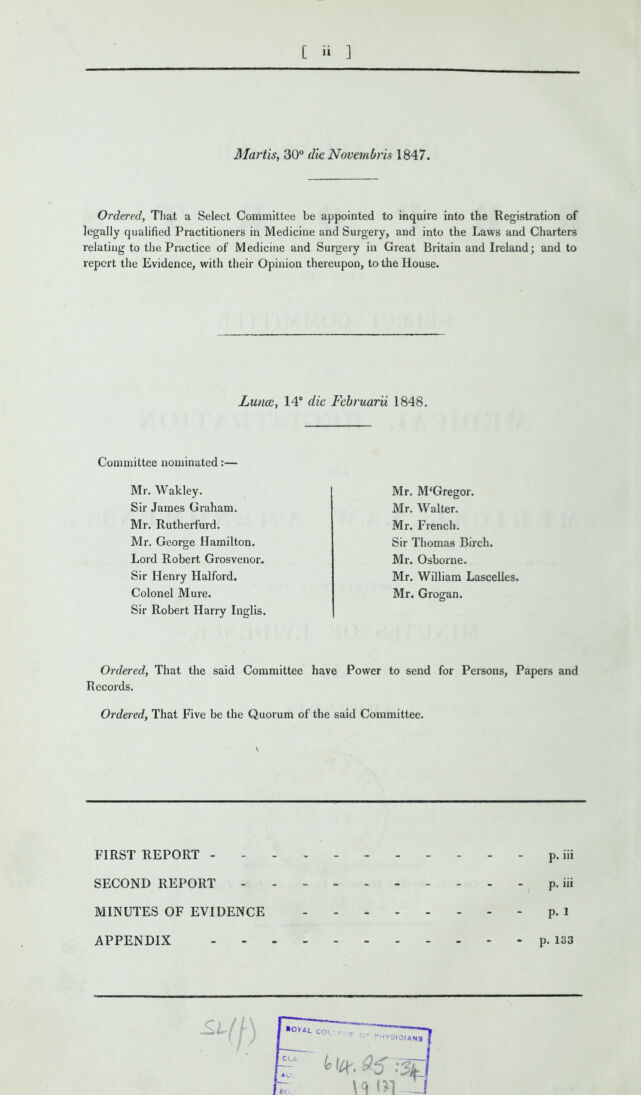
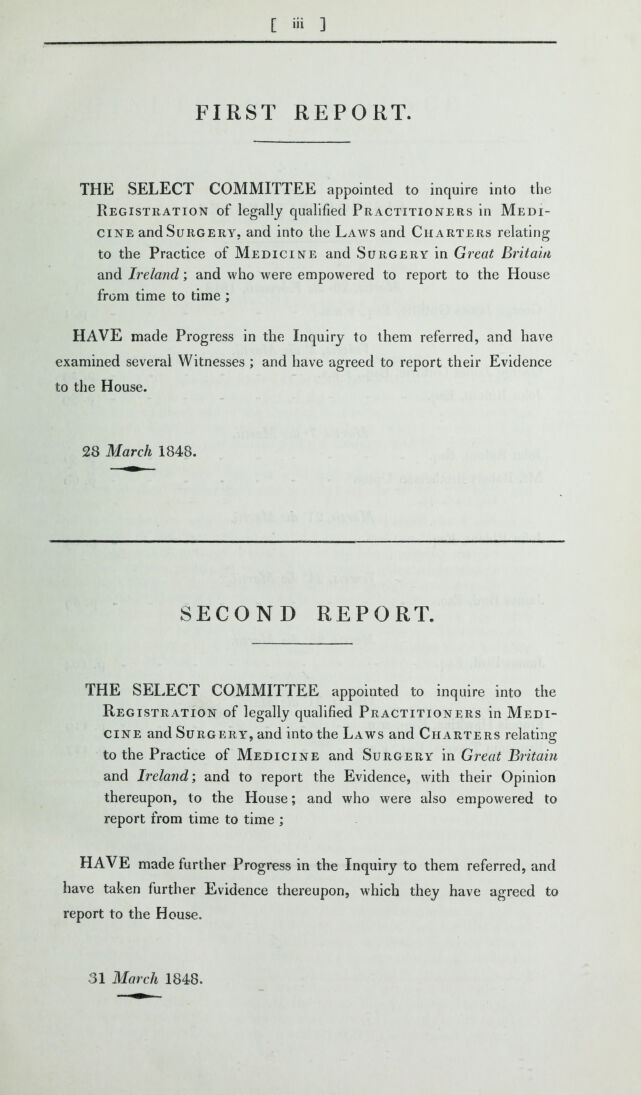
First and second reports from the Select Committee on Medical Registration and Medical Law Amendment : together with the minutes of evidence and appendix.
- Great Britain. Parliament. House of Commons. Select Committee on Medical Registration and Medical Law Amendment.
- Date:
- 1848
Licence: Public Domain Mark
Credit: First and second reports from the Select Committee on Medical Registration and Medical Law Amendment : together with the minutes of evidence and appendix. Source: Wellcome Collection.
Provider: This material has been provided by Royal College of Physicians, London. The original may be consulted at Royal College of Physicians, London.
22/146 page 18
![F. R. S. 29 February 1848. 18 MINUTES OF EVIDENCE TAKEN BEFORE THE general practical experience of the Examiners has pointed out to several of us that it would be better to make an alteration, so as to allow two consecutive years for those who could go through it, and where they could not, to insist upon the third winter session, which would give a benefit to the public, because it becomes very expensive to many persons who cannot afford to main- tain their children for the time required. 100. Do you find the practice of cramming go on to a great extent?—Yes, and principally upon that account. 101. That is attended with very bad effects, is not it ?—Yes, so far as it leads to their forgetting what they have learned ; no man remembers what he learns unless he learns by his eyes and his hands ; learning by his memory alone does not answer ; the injury which cramming does is, that it enables candidates to go through their examination without possessing the solid knowledge which ought to be required of them. 102. You require actual dissection as a part of the examination, do not you? —No ; we do not make them dissect, neither for the ordinary diploma nor for the fellowship, when members of eight years’ standing ; we have the certificates of the teachers that they have done so, and we examine them in such parts, generally bones, as we have before us; a good and experienced examiner is never deceived ; he may be too lenient. 103. Colonel Mure.] You made some remark at the commencement of your examination relative to surgeons practising in the twofold capacity of surgeon and apothecary; the remark was with reference to qualification ; the examina- tion for that purpose is an examination by the Apothecaries Company, is it not ?—The examination now is on the part of the Apothecaries Company. 104. Is not it part of the regulation of the Apothecaries Company that everybody admitted to their faculty should serve an apprenticeship of five years ? —That is one of those things which it is most desirable to get rid of. 105. Is a qualified surgeon who wishes to qualify as an apothecary exempt from that apprenticeship ?—No ; but it is evaded ; it is one of those bad laws that should never have been enacted ; the Society of Apothecaries obtained an Act of Parliament to regulate them as apothecaries only; by having an Act of Parliament, and the College of Surgeons having a charter only, they were enabled to do as they pleased, and it has been the cause of much annoyance between the two bodies ; because the Society of Apothecaries were able to say, we will have such and such things done, and if persons do not comply with them they are able to prosecute them ; the College of Surgeons can only say, we wish to do so and so, but they have been unable to resist the influence of the Society of Apothecaries ; consequently both parties have, to a certain extent, disagreed ; it is desirable that both bodies should be placed upon the same footing, either by an Act of Parliament or charter, so that one party should not interfere with the other ; there are, say 12 branches of science in which candidates are examined; an examination in 12 branches of science should not be conducted at one time, and by one body ; it therefore appears advisable that the College of Surgeons should examine in anatomy, physiology and surgery, and that the Society of Apothecaries, or any other properly con- stituted body, should examine in the remaining sciences necessary to constitute a practitioner in midwifery, pharmacy and physic. 106. Then, according to the existing practice, a person, in order to practise simply as an apothecary, requires to go through an apprenticeship of five years; but a qualified surgeon, in order to practise as an apothecary also, may do so by merely undergoing an examination ?—By the regulations of the College of Sur- geons, lie must study for one year in the shop of an apothecary ; he must study for one year under a physician, but he must be three years under the eye of an hospital physician and surgeon, to be a surgeon. 107. What is the distinction between the two; is not it that four years are required to qualify to practise as a surgeon ?—Yes. 108. And one year to practise as an apothecary?—Yes, in addition, making five years. 109. Mr. Grogan.] You have given in to the Committee the curricula of three periods ; the inquiry which the Committee are carrying on, you are aware, is with regard to a medical registration ; is the curriculum that you handed in, as in use at present in the College of Surgeons in London, more severe or more general](https://iiif.wellcomecollection.org/image/b24906773_0024.jp2/full/800%2C/0/default.jpg)


 No text description is available for this image
 No text description is available for this image
 No text description is available for this image