First and second reports from the Select Committee on Medical Registration and Medical Law Amendment : together with the minutes of evidence and appendix.
- Great Britain. Parliament. House of Commons. Select Committee on Medical Registration and Medical Law Amendment.
- Date:
- 1848
Licence: Public Domain Mark
Credit: First and second reports from the Select Committee on Medical Registration and Medical Law Amendment : together with the minutes of evidence and appendix. Source: Wellcome Collection.
Provider: This material has been provided by Royal College of Physicians, London. The original may be consulted at Royal College of Physicians, London.
26/146 page 22
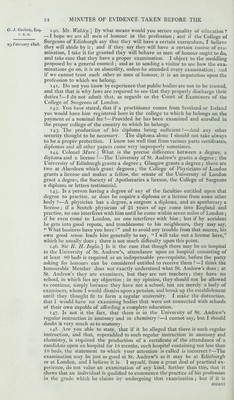
![G. J. Guthrie, Esq. r. n. s. 2cj February 1848. 140. Mr. Wakley.] By what means would you secure equality of education? — I hope we are all men of honour in the profession ; and if the College of Surgeons of Edinburgh say that they will have a certain curriculum, I believe they will abide by it; and if they say they will have a certain course of exa- mination, I take it for granted they will behave as men of honour ought to do, and take care that they have a proper examination. I object to the meddling proposed by a general council ; and as to sending a visitor to see how the exa- minations go on, it is an absurdity, unless he attended every examination; and if we cannot trust each other as men of honour, it is an imputation upon the profession to which we belong. 141. Do not you know by experience that public bodies are not to be trusted, and that that is why laws are required to see that they properly discharge their duties?—I do not admit that, as regards us the Court of Examiners of the College of Surgeons of London. 142. You have stated, that if a practitioner comes from Scotland or Ireland you would have him registered here in the college to which he belongs on the payment of a nominal fee?—Provided he has been examined and enrolled in the proper college of the country to which he belongs. 143. The production of his diploma being sufficient?—And any other security thought to be necessary. The diploma alone I should not take always to be a proper protection. I know too well that from various parts certificates, diplomas and all other papers come very improperly7 sometimes. 144. Colonel Mure.'] What is the precise difference between a degree, a diploma and a license?—The University of St. Andrew’s grants a degree; the University of Edinburgh grants a degree ; Glasgow grants a degree ; there are two at Aberdeen which grant degrees; the College of Physicians of London grants a license and makes a fellow, the senate of the University of London grant a degree, the Society of Apothecaries a license, the College of Surgeons a diploma or letters testimonial. 145. Is a person having a degree of any of the faculties entitled upon that degree to practise, or does he require a diploma or a license from some other body ?—A physician has a degree, a surgeon a diploma, and an apothecary a license; if a Scotch physician of 21 years of age come into England and practise, no one interferes with him until he come within seven miles of London ; if he even come to London, no one interferes with him ; but if hy accident he gets into good repute, and troublesome to his neighbours, they may7 say7, “ What business have you here ?” and to avoid any trouble from that source, his own good sense leads him generally7 to say7, “I will take out a license here,” which he usually does ; there is not much difficulty7 upon this point. 146. Sir R. H. Inglis.] Is it the case that though there may be no iiospital in the University of St. Andrew’s, attendance upon an hospital consisting of at least 80 beds is required as an indispensable pre-requisite, before the party asking for honours can be considered entitled to receive them ? — I think the honourable Member does not exactlv understand what St. Andrew's does ; at St. Andrew’s they are examiners, but they are not teachers ; they have no school, in which lies my objection ; in my7 opinion, they should not be allowed to continue, simply7 because they have not a school, but are merely a body of examiners, whom I would dismiss upon a pension, and break up the establishment until they thought fit to form a regular university7. I make the distinction, that I would have no examining bodies that were not connected with schools of their own capable of affording a complete education. 147. Is not it the fact, that there is in the University of St. Andrew’s regular instruction in anatomy7 and in chemistry ?—I cannot say, but I should doubt it very much as to anatomy7. 148. Are you able to state, that if it be alleged that there is such regular instruction, and that, superadded to such regular instruction in anatomy7 and chemistry, is required the production of a certificate of the attendance of a candidate upon an hospital for 18 months, such hospital containing not less than 18 beds, the statement to which your attention is called is incorrect?—The examination may be just as good at St. Andrew’s as it may be at Edinburgh or at London, and I believe it is. I myself, from a great deal of practical ex- perience, do not value an examination of any kind, further than this, that it shows that an individual is qualified to commence the practice of his profession in the grade which he claims by undergoing that examination ; but if it is meant](https://iiif.wellcomecollection.org/image/b24906773_0028.jp2/full/800%2C/0/default.jpg)



 No text description is available for this image
 No text description is available for this image
 No text description is available for this image