A handbook of the diseases of the eye and their treatment / by Sir Henry R. Swanzy and Louis Werner.
- Swanzy, Henry R. (Henry Rosborough), 1843-1913
- Date:
- 1912
Licence: In copyright
Credit: A handbook of the diseases of the eye and their treatment / by Sir Henry R. Swanzy and Louis Werner. Source: Wellcome Collection.
Provider: This material has been provided by The University of Leeds Library. The original may be consulted at The University of Leeds Library.
147/700 (page 119)
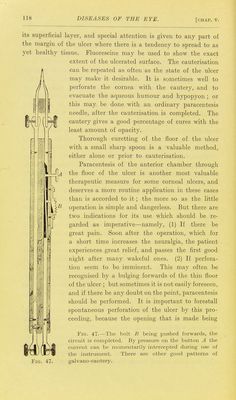
![Chap, v.] THE O&RNEA. 110 linear heals easily, and leaves but a slight scar without anterior synechia;; while the natural opening would be a complete loss of substance, and would, therefore, the more readily involve adhesion of the iris in the resulting, and comparatively extensive, cicatrix. Other indications for the operation are increased tension, and the presence of a large hypopyon. Paracentesis of the anterior chamber is best performed by means of a paracentesis needle (Fig. 48), which is a small somewhat shovel-shaped blade. If this be not at hand, a small keratome, or a broad needle, or a Graefe's cataract knife will answer the purpose. The eye having been cocainised, a spring lid-speculum is inserted, the eye is fixed with a fixation forceps, and the point of the para- centesis needle applied to the floor of the ulcer, in such a way that the plane of the little blade may be at an angle of about 45° with that of the floor of the ulcer. The point is pushed gently through the floor, and the plane of the blade is then immediately changed, so that, as the instrument is being advanced up to the hilt, it may be almost in contact with the posterior surface of the cornea. The instrument should be withdrawn very slowly, in order that the aqueous humour may flow off gradually, and not with a rush. If these precautions be taken, there need be no danger of injury to the crystalline lens, or of pro- lapse of the iris into the incision. Should prolapse occur, it can usually be reposed with the spatula. It may happen that when the needle has been withdrawn a con- siderable portion of the aqueous humour may remain in the anterior chamber, unable to escape owing to the valve- like closure of the wound. It should be evacuated by making the wound gape by gentle pressure with a spatula on its posterior lip. If it be desirable to tap the anteriorFlG- 48 chamber on the next day, this can be done by simply opening up the wound with a spatula, or with the probe-like instrument at the other end of the handle (Fig. 48), without the aid of any cutting instrument. Subconjunctival injections of solution of oxycyanate of mercury (I in 5000) or of solution of chloride of sodium (4 per cent.) enter largely into the therapeutics of corneal disease, and of disease in](https://iiif.wellcomecollection.org/image/b21512589_0147.jp2/full/800%2C/0/default.jpg)