Some remarks on the treatment of unavoidable hæmorrhage by extraction of the placenta before the child : with a few observations on Dr. Lee's objections to the practice / by J.Y. Simpson.
- James Young Simpson
- Date:
- [1845]
Licence: Public Domain Mark
Credit: Some remarks on the treatment of unavoidable hæmorrhage by extraction of the placenta before the child : with a few observations on Dr. Lee's objections to the practice / by J.Y. Simpson. Source: Wellcome Collection.
5/8 page 5
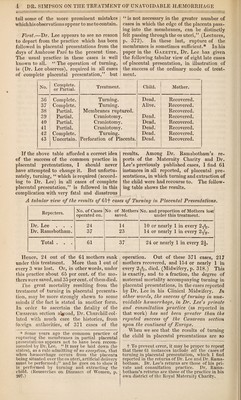
![very mortal in the hands of two such dis¬ tinguished accoucheurs as Dr. Ramsbotham and Dr. Lee, what degree of success can we expect to follow it in the hands of the general mass of medical men ? * Last year Dr. Lee most truly and justly remarked of turning in placental presen¬ tation, “ At best it is a dangerous operation, and you can never tell with certainty whether or not the patient will recover after its per¬ formance, however easily it may have been effected.” (Lectures, p. 373.) Secondly.—Dr. Lee seems to argue as if I recommended the artificial detachment of the placenta in all forms of placental presentation in which turning is at present adopted. On the contrary, I have explicitly mentioned it as a mode of treatment to be adopted when rupturing of the membranes is insufficient, and turning is either inapplicable or unusually dangerous. I believe it will be found, for instance, the proper line of practice in severe cases of unavoidable haemorrhage compli¬ cated with an os uteri so insufficiently dilated and undilatable as not to allow, with safety, of turning; in most primiparae; in many of the cases in which placental presentations are (as very often happens) connected with premature labour and imperfect development of the cervix and os uteri; in labours supervening earlier than the seventh month; when the uterus is too contracted to allow of turning ; when the pelvis or passages of the mother are organically contracted ; in cases of such extreme exhaustion of the mother as forbid immediate turning or forced delivery ; when the child is dead ; and when it is premature and not viable. As an illustration, I shall take the first set of cases I have adverted to: “ There is not unfrequently (says Dr. Lee) most profuse and alarming flooding from complete placental presentation, where the os uteri is so thick, rigid, and undilatable, that it is impossible to introduce the hand into the uterus without producing certain mischief. In 13 (he adds) out of the 36* cases contained in the following table, the os uteri was rigid and undilatable.” Hence, this complication occurred a^ frequently in Dr. Lee’s practice as in about one out of every three of his pla¬ cental presentations. In his Clinical Mid¬ wifery, out of 35f cases alleged to be reported, in 11 there had been more or less rigidity of the os uteri with dangerous hsemorrhage. From the mode in which the individual reports are drawn up, it is by no means easy to determine exactly and with perfect pre¬ cision, the “ elevenj” cases which Dr. Lee himself classes under this remark, but I believe I have correctly given them in the following table :— Table of Eleven Cases of Placental Presentation, from Dr. Lee's Clinical Midwifery : shewing the combination of “ more or less rigidity of the os uteri, with dangerous haemorrhage.” No. Complete or Partial Presentation. Treatment. Child. Mother. 266 267 271 272 274 277 282 283 284 285 287 Not stated. Not stated. Complete. Partial. Partial. Complete ? Complete. Complete ? Complete. Complete ? Complete. Turning. Extraction by foot. Turning. Membranes ruptured. Membranes ruptured. Turning. Extraction by feet. Craniotomy. Extraction by feet. Turning. Extraction by feet. Alive. Not stated. Not stated. Dead. Not stated. Alive. Not stated. Dead. Dead. Not stated. Not stated. Died. Recovered §. Died. Died. Died. Died. Died. Died. Recovered. Died. Recovered||. * Dr. Lee has here committed a statistical error in regard to the number of placental presentations occurring in his own practice, and reported in his Lectures. The number should be 38, and not 36. f Another statistical mistake of Dr. Lee regard¬ ing the number of his oivn cases. His Clinical Midwifery contains 36 and not 35 cases of pla¬ cental presentation. See other of Dr. Lee’s in¬ advertent errors on this head mentioned in a sub¬ sequent note respecting the number of children lost in these and other placental presentations. $ Probably the number 11 is indicative of ano¬ ther error in Dr. Lee’s reports. Dr. Lee, in his Lectures, adverts to 13 such cases ; in his Clinical Midwifery, he limits the number toll. If the cases were 13 in number, then the number 11 is wrong ; or the reverse ; for although he has re¬ ported 38 cases, in all,in bis Lectures, and 36 in his clinical work, yet neither of the two additional cases reported in the Lectures presented any diffi¬ culty on the part of the os uteri. In one case (Case 37) it was “ little dilated but dilatable in the second (Case 38) the report is, “ os uteri dilated to size of a crown-piece, dilatable.” If we admit 13 instead of 11 cases, we must, I believe, in¬ clude Cases 260 and 289 of the Clinical Report. In both of these cases the mothers died. This would give us in the text a proportion of ten ma¬ ternal deaths out of thirteen mothers operated on. § “ A violent rigor (Dr. Lee states) followed [the delivery] which threatened for a time to destroy the patient. Bottles of hot water were applied to the feet and pit of the stomach, the whole body was covered with hot blankets, and brandy was freely administered. She slowly recovered from the effects of the immense loss of blood.” || “ The pulse could scarcely be perceived for](https://iiif.wellcomecollection.org/image/b30559601_0005.jp2/full/800%2C/0/default.jpg)