An introduction to pathology and morbid anatomy / by T. Henry Green.
- Green, T. Henry (Thomas Henry), 1841-1923
- Date:
- 1895
Licence: Public Domain Mark
Credit: An introduction to pathology and morbid anatomy / by T. Henry Green. Source: Wellcome Collection.
494/616 (page 466)
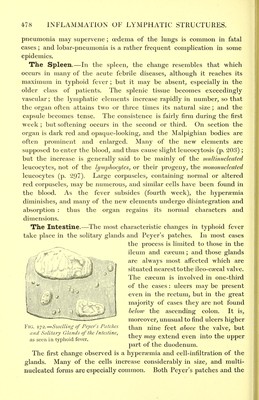
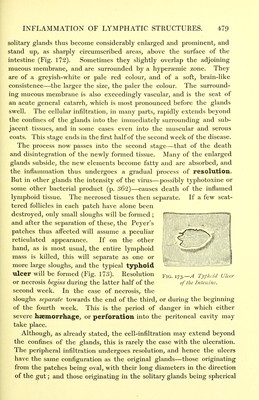
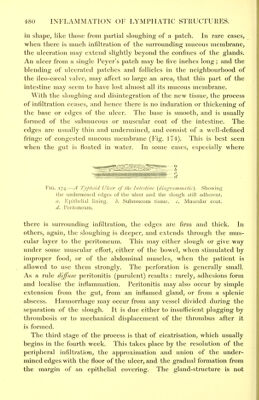
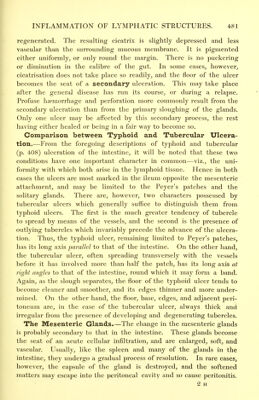
![elasticity of a vessel, and render imperfect the circulation in the parts beyond. Moreover, the inelastic vessel-wall tends slowly to yield under the constant pressure to which it is subjected. General dilatation of the vessel results : when this is extreme, it is known as a fusiform aneurysm. When an atheromatous ulcer forms, the vessel is specially weakened at one spot, and a local dilatation or sacculated aneurysm may occur. When this has reached a certain size, the wall may rupture, and fatal haemor- rhage result. If the external coats have been uniformly strengthened by the forma- tion of chronic inflammatory tissue in them, this result will be proportionately delayed. If an atheromatous abscess bursts before the tissues round its margin have been matted together Fig. i6i. —Miliary Aneurysms on a Branch of the Middle Cerebral Artery, from a case of cerebral haemorrhage. They are not unlike birds' nests in a tree. (From a specimen by Dr. Mott.) Fig. 162,—Section of an Atheromatous Aorta: the intima is much thickened (i); passing in from the externa through the media are vessels, about which haemorrhage [h] has occurred; the lumina of the main trunks of these {e) in the externa are almost obliterated by an endarteritis. (Molt.)](https://iiif.wellcomecollection.org/image/b20389863_0494.jp2/full/800%2C/0/default.jpg)