Dictionary of English literature, being a comprehensive guide to English authors and their works / [William Davenport Adams].
- William Davenport Adams
- Date:
- [1879?]
Licence: Public Domain Mark
Credit: Dictionary of English literature, being a comprehensive guide to English authors and their works / [William Davenport Adams]. Source: Wellcome Collection.
689/720 (page 681)
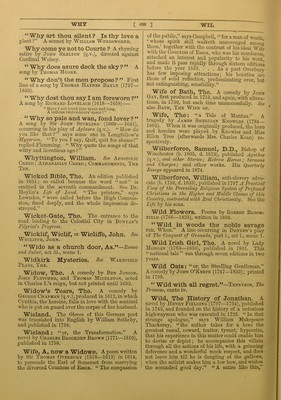
![an Ear and Eye Witness (1650). This work is an amusing and. valuable, if exaggerated, description of the ting and his household. “Well of English undefyled.’ ’ A descrip- tion applied to Chaucer by Spenser in his Faerie Queene, book iv., canto ii., stanza 32 :— “ Dan Chaucer, well of English undefyled. On Fame's eternal bead-roll worthie to be pyled.” “Dan” is a corruption of dominus, master. Well Ordering and Carriage of a Man’s Life, Precepts and Directions for. Addressed to his son Robert, by William Cecil, Lord Burleigh (1520—1598), and published in 1636. They consist of “ precepts and directions ” on such subjects as the choice of a wife, domestic economy, the education of children, suretyship and borrowing, and similar practical matters. Of children, he says: “ Praise them openly, reprehend them secretlyof girls, “ Marry thy daughters in time, lest they many themselves;” and of borrow- ing, “ Neither borrow money of a neighbour nor a friend, but of a stranger, where, paying for it, thou shalt hear no more of it.” “Well! thou art happy, and I feel.” First line of a lyric by Lord Byron (1788—1824), written on November 2, 1808, and addressed to his former love, Mary Chaworth, at that time a married woman. “Well-bred whisper close the scene. And with a.” See book ii. of Cowper’s poem of The Task (q.v.). Weller, Sam. Son of Tony Weller (q.v.), and originally “boots” at an inn; afterwards servant to Mr. Pickwick, in Dickens’s Pickwick Papers. Weller, Tony. A stage-coachman, and father of the above, in Dickens’s Pickwick Papers (q.v.). He is noted for his horror of widows, one of whom he has married. Wellington, Ode on the Death of the Duke of, by Alfred Tennyson, was first pub- lished in 1852, the day after the duke’s funeral. A second edition, considerably altered, appeared in 1853, and the poem was still further retouched before it was included in the Maud volume in 1855. It begins— “ Bury the Great Duke With a people's lamentation,” and includes a large number of familiar lines. Wells, Charles, poet, is tho author of Joseph and his Brethren, a scriptural drama, which was reprinted in 1876, with a critical essay by Algernon Charles Swinburne. ‘‘Wells of fire.” See “Laburnums drop- ping.” Welsted, Leonard, poet (b. 1689, ch 1747), wrote Epistles, Odes, $c., with a translation of Longinus on the Sublime (1724); The Genius (q.v.); a prologue and epilogue to Steele’s Conscious Lovers; The Triumvirate (q.v.); The Dissembled Wanton; The Apple Pie ; and many other composi- tions of a similar character. His Works, in prose and verse, were published with notes and Memoir of the author, by John Nichols, in 1787. “Weltering in his blood, And.” — Dryden, Alexander's Feast. Wemmick. The lawyer’s clerk in Dickens’s story of Great Expectations (q.v.); famous for his “ castle ” at Walworth, and for his peculiar ideas of portable property. Wenonah. The mother of Hiawatha, in Longfellow’s poem of the latter name (q.v.). Wentworth, in Plumer Ward’s novel of De Vere: or, the Man of Independence, is intended as a representation of George Canning, the statesman, “ the contention in whose mind between literary tastes and the pursuits of ambition is beautifully delineated.” Werburgh, Life of St., by Henry Brad- shaw (d. 1513); a poem, which, besides telling the story of St. Werburgh’s life, includes a de- scription of the kingdom of the Mercians, the lives of St. Ethelred and St. Sexburgh, and an account of the foundation of the city of Chester. Were na my Heart licht I wad dee. A favourite Scottish song, from the pen of Lady Grisell Baillie (1665—1746) ; first printed in the Orpheus Caledonius about 1725, and reproduced by Allan Ramsay in his Tea-Table Miscellany. See Lady Baillie’s Memoirs by her daughter (1822). Werner: “or, the Inheritance.” A tragedy, in five acts, by Lord Byron (1788—1824), pub- lished in 1822, and, in the words of the author, “ taken entirely from the German’s Tale, Eruitzner, published many years ago in Lee’s Canterbury Tales [q.v.], written (I believe) by two sisters, of whom one furnished only this story and another, both of which are considered superior to the re- mainder of the collection. I have adopted the characters, plan, and even the language of many parts of this story. Some of the characters are modified or altered, a few of the names changed, and one character (Ida of Stralenheim) added by myself; but in the rest the original is chiefly followed.” Werther, The Sorrows of. A humorous poem by William Makepeace Thackeray (1811 —1863) in ridicule of Goethe’s famous novel. It begins— “ Werther had a love for Charlotte, Such as words could never utter: Would you know how first he met her? She was cutting bread and butter.” Wesley ? Charles, hymn-writer (b. 1708, &. 1788), published Hymns for the Public Thanks- giving Day, Oct. 9 (1746); Hymns and Sacred Poems (1749); Hymns for the Nativity (1750); Hymns for the Ascension Day (1753) ; Gloria Patri: or, Hymns to the Trinity (1753); Funeral Hymns](https://iiif.wellcomecollection.org/image/b24861601_0689.jp2/full/800%2C/0/default.jpg)