Lectures and essays on fevers and diphtheria, 1849 to 1879 / by Sir William Jenner.
- Date:
- 1893
Licence: Public Domain Mark
Credit: Lectures and essays on fevers and diphtheria, 1849 to 1879 / by Sir William Jenner. Source: Wellcome Collection.
Provider: This material has been provided by the Royal College of Physicians of Edinburgh. The original may be consulted at the Royal College of Physicians of Edinburgh.
15/614
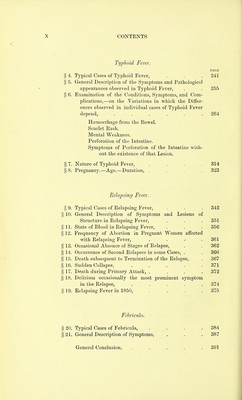
![1853. IV. Lectures on the Acute Specific Diseases ; being the GuLSTONiAN Lectures delivered at the Eotal Col- lege OF Physicians of London. PAGE Lecture I., ....... 399 Necessity for analysis of observed facts—Sydenham on Acute Diseases—His classification of fevers—Epidemic constitution—Comparison of small-pox with measles— Analogies with plant life—The two main divisions of acute diseases having definite duration and attended by disseminated lesions—General symptoms—Rigors—Tem- perature of skin—Pain in back—Headache—Mental condition—Malaise—Pulse-rate—Influence of perspira- tion on pulse-rate—Local lesions—Cutaneous eruptions— Lesions of internal organs—Duration—Mode of deter- mination—Its definite limit—Specific cause—Contagion —Pathological affinities. Lecture II., . . . . . . . 424 Varieties of acute specific diseases—A. Their essential causes—Differences in severity—Influence of specific local processes—As to skin aflection—As to laryngeal and intestinal lesions—Occurrence of local complications. B. Determining causes of variations—Vital conditions of patient—External condition—Atmospheric changes— Epidemic constitution—Endemic influences. C. Pheno- mena of variations—In Small-pox—Typhoid fever— Scarlatina—Measles—Typhus fever—Relapsing fever— Erysipelas. Lecture III., ....... 447 Each of the acute specific diseases has preserved, for the last two centuries at least, its distinctive characters— Circumstances which have led to the confounding together diseases so opposite—Two great classes of cases received into a fever hospital as cases of fever which do not belong to the order of acute specific diseases : 1st, Diseases in j which the constitutional disturbance is secondary to some local aflection, e.g. pneumonia and intracranial inflamma- tion—The diagnosis of these diseases ; 2nd, General dis- eases not due to a specific cause—Febricula—Pyogenic fever or the acute purulent diathesis—Acute tuberculosis. [Medical Times, 1853.] 1879. V. An Address on the Treatment of Typhoid Fever delivered before the Midland Medical Society at Birmingham, November 4th, 1879, . . . 471 [The Lancet, 1879, Vol. ii.]](https://iiif.wellcomecollection.org/image/b2192272x_0015.jp2/full/800%2C/0/default.jpg)



 No text description is available for this image
 No text description is available for this image
 No text description is available for this image