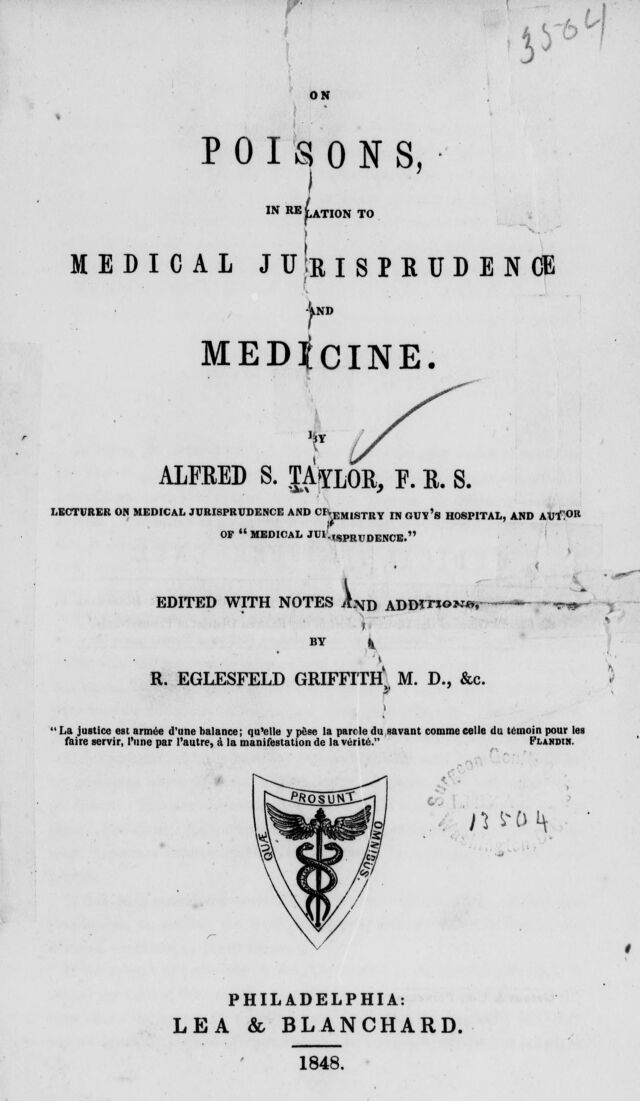
On poisons, in relation to medical jurisprudence and medicine / by Alfred S. Taylor ; edited, with notes and additions, by R. Eglesfeld Griffith.
- Alfred Swaine Taylor
- Date:
- 1848
Licence: Public Domain Mark
Credit: On poisons, in relation to medical jurisprudence and medicine / by Alfred S. Taylor ; edited, with notes and additions, by R. Eglesfeld Griffith. Source: Wellcome Collection.
Provider: This material has been provided by the National Library of Medicine (U.S.), through the Medical Heritage Library. The original may be consulted at the National Library of Medicine (U.S.)
38/723
![of conia into the femoral vein of a dog. There was no appreciable interval between the moment at which the poison was injected and that in which the animal died: certainly the interval did not exceed three, or at most four, seconds (On Poisons, p. 8.) Mr. Blake performed the same experiment; but he found that fifteen seconds elapsed before there were any symptoms, and the animal did not die until thirty seconds had elapsed! He repeated this experiment four times, and in no instance did any symptoms manifest themselves in less than fifteen seconds! This was not owing to any want of virulence in the poison; for by no other substance that he used, had death been produced in so short a time (Ed. Med. and Surg. Journ. 53, p. 44.) Here, then, are conflicting re- sults, showing, as it appears to me, that there is something fatal to a correct determination of the rapid action of poisons by these injection-experiments. It is not likely that Dr. Christison should have been mistaken in his estimate of the time; and, therefore, his result, together with similar results of rapid action obtained by others in operating with other poisons, shows that while Mr. Blake's theory, that nine seconds always elapse between the introduction of a poison into the capillaries or veins and the appearance of its first effects, may be in accordance with his own experiments, it is inconsistent with the re- sults obtained by others whose observations were made irrespectively of any theory on the subject. Admitting that the absorption of poisons takes place so rapidly as he alleges, it is of course a pure question of fact as to the time at which their effects begin to manifest themselves. In experimenting upon cats with prussic acid, I have seen the effects produced so rapidly, that there was no sensible interval between the application of the poison to the tongue and their production; and death took place in a period of time actually shorter than that which is here stated to be necessary for the appearance of the first symp- toms of poisoning. In Freeman's case (see post, poisoning by hydrocyanic acid,) it was stated by the medical witnesses, that a dog died in three seconds from the effects of a large dose of hydrocyanic acid. Unless, then, it be rendered probable that a poison may be circulated through the whole of the body in a much shorter period of time than that stated by Mr. Blake, we must admit that these agents do occasionally produce their effects by what is termed sympathy, or by a shock transmitted through the nervous system. Some poisons appear to act only by absorption, and others independently of that process. Thus, to take two animal poisons, that of the rattle-snake produces symptoms instantly, or within a few seconds;—certainly within a period of time so short as not easily to allow of the hypothesis of the poison being diffused by absorption. On the other hand, the poison of hydrophobia by its long incubation appears to act by absorption; for we can hardly imagine, if it acted sympathetically on the nerves by contact, that its operation should be often suspended for so many months. It seems to me that if we are to take the rapid effect of a poison as favourable to the supposition of its action by sympathy, we must take#its very slow operation as favourable to the hypothesis that absorption is a state necessary to its action on the system. This would explain why symptoms have not appeared where the bitten part has been early excised. (See Hydrophobia, post.) > [The poison of the rattle-snake is by no means so rapid in its effects as stated by Mr. Taylor, and in most cases there is every evidence of its absorp- tion, as the swelling and pain gradually extend from the wounded part towards the great animal centre, and may be retarded by the application of a ligature between this part and the heart.—G.] It appears probable that even with the same poison, absorption may be sometimes necessary to its action, and at other times not. Alcohol presents this anomaly. A man has been known to fall senseless instantaneously from a powerful dose of alcohol; in other instances, some minutes have elapsed](https://iiif.wellcomecollection.org/image/b21158071_0038.jp2/full/800%2C/0/default.jpg)