Scrutiny : third progress report : seventh report of session 2004-05 : report, together with formal minutes and appendices / House of Lords, House of Commons, Joint Committee on Human Rights.
- Great Britain. Parliament. Joint Committee on Human Rights
- Date:
- 2005
Licence: Open Government Licence
Credit: Scrutiny : third progress report : seventh report of session 2004-05 : report, together with formal minutes and appendices / House of Lords, House of Commons, Joint Committee on Human Rights. Source: Wellcome Collection.
41/52 page 37
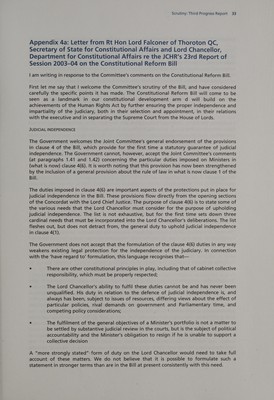
![clause 57 emphasises that, in relation to any actual selection, merit is the only criterion. The Government believes that this strikes the right balance. Sir Cohn Campbell's ‘audit’ role reflects the fact that at present the selection or appointment of judges is almost entirely within the hands of myself and my officials. Given the concerns that have been expressed about that system, its lack of transparency, and its potential vulnerability to party political manipulation, it has in recent years been thought necessary to have some external scrutiny and guarantee of the integrity of the process. This has extended beyond an ability to consider actual complaints to an ability to examine and comment upon the policies and practices involved in judicial appointments generally. This situation will be transformed by the Bill, which will place the selection of judges in the hands of an independent Commission, with only a limited mole for the Lord Chancellor, who will have no ability to appoint someone not selected by the Commission. The Commission itself will be the Lord Chancellor's main source of independent advice on all matters to do with judicial appointments. The Commission will be required to make annual reports and any trends in relation to the appointments made will of course be monitored by the Commission, by the Department for Constitutional Affairs, and, | would expect, by Parliament itself. | believe that there will still be a good reason for complaints about maladministration in making selections or appointments to be considered by a body independent of the Commission itself, which is why the Bill gives this role to the Judicial Appointments and Conduct Ombudsman. | do not believe it would be useful, however, for the Ombudsman to be set up as a source of rival advice on wider issues of judicial appointments policy or practice. | certainly do not consider this is necessary in order to comply with our obligations in relation to equal opportunities. This letter inevitably concentrates on the areas where | disagree with or have reservations about the Committee’s views; | would not like to conclude it without recording once again my gratitude to the Committee for its helpful consideration of all these issues, and for the way in which the report has informed the debate. | am arranging for copies of this letter to be placed in the Libraries of both Houses. 29 January 2005 Appendix 4b: Letter from the Chair to Rt Hon Lord Falconer of Thoroton QC, Secretary of State for Constitutional Affairs and Lord Chancellor, Department for Constitutional Affairs Thank you for your letter of 29 January comprising your response to the comments on the Constitutional Reform Bill contained in our 23 Report of last Session. We are grateful for the serious consideration you have given to our Report, and for setting out so fully the reasons for your disagreement with certain of our conclusions. We will publish your response in full in one of our forthcoming scrutiny progress reports. There is one point on which we would be grateful for further clarification. This is your statement that “the Lord Chancellor’s ability to fulfil [the clause 4(6)] duties cannot be and has never been unqualified. His duty in relation to the defence of judicial independence is, and always has been, subject to issues of resources, differing views about the effect of particular policies, rival demands on government and Parliamentary time, and competing policy considerations”. We find this argument, that the duty to defend judicial independence is qualified by other considerations, including even “competing policy considerations”, surprising. The international standards to which we referred in our report are unequivocal in their](https://iiif.wellcomecollection.org/image/b32221873_0041.jp2/full/800%2C/0/default.jpg)


 No text description is available for this image
 No text description is available for this image
 No text description is available for this image