On sanitary legislation and administration in England : an address, portions of which were read before the Public-Health Department of the National Association for the Promotion of Social Science, at its Inaugural Meeting, held at Birmingham, in October 1857 / by Henry Wyldbore Rumsey.
- Henry Wyldbore Rumsey
- Date:
- 1858
Licence: Public Domain Mark
Credit: On sanitary legislation and administration in England : an address, portions of which were read before the Public-Health Department of the National Association for the Promotion of Social Science, at its Inaugural Meeting, held at Birmingham, in October 1857 / by Henry Wyldbore Rumsey. Source: Wellcome Collection.
Provider: This material has been provided by The Royal College of Surgeons of England. The original may be consulted at The Royal College of Surgeons of England.
4/86
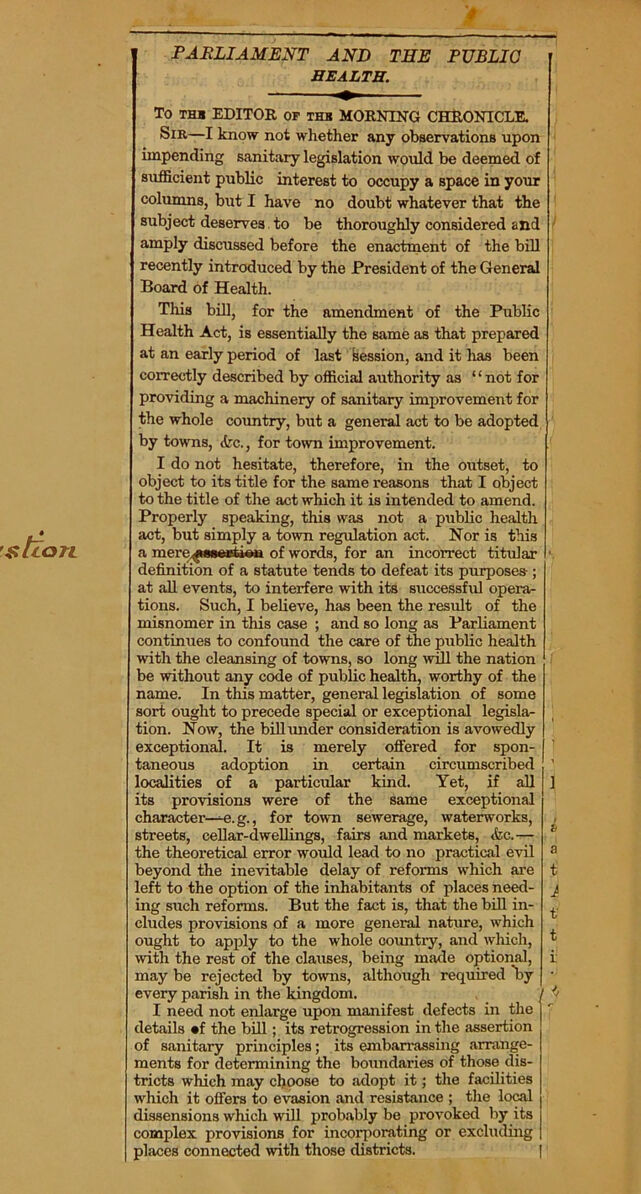
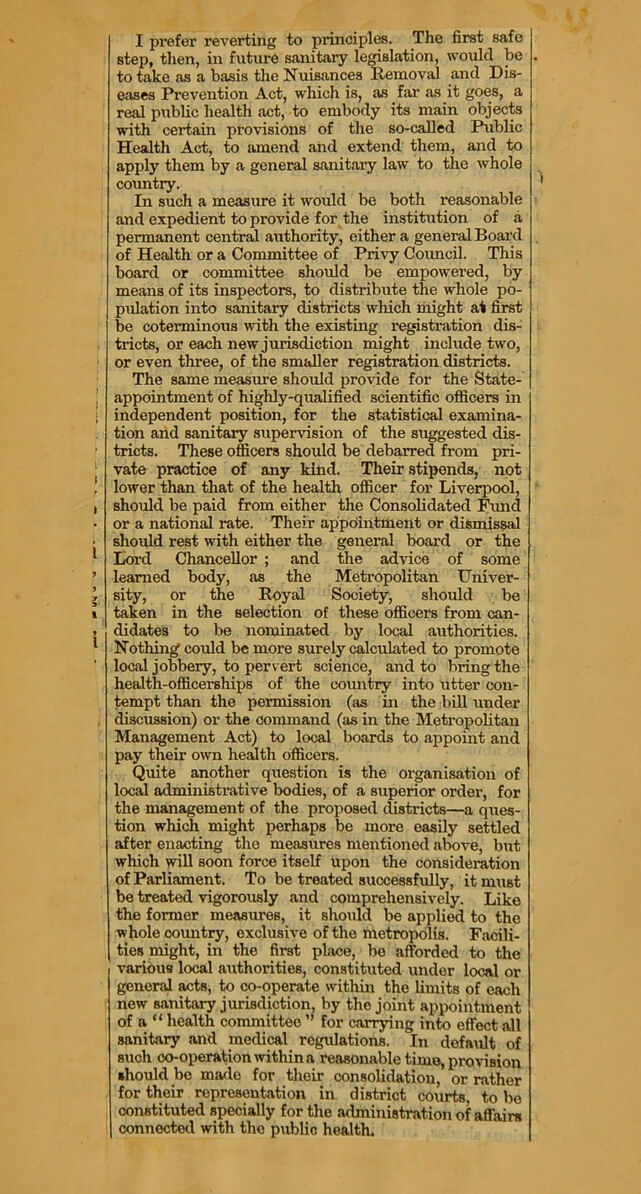
![The Legislature might afterwards proceed,with fewer difficulties and larger experience, to decide upon the nature and extent of those special enact- ments which would apply only to “ places having the character of towns to determine by simple , methods and on rational principles, the boundaries of these populous wards ;to provide for the prompt extension of such boundaries, on sufficient cause being shown by the report of an inspector ; and to 1 settle the conditions upon which central interven- tion shall take place in defect of local action, l Many of the objections now urged against the compulsory application of preventive regulations 5 to towns, are due to the fact that there is no ge- neral machinery for the sanitary management of j the country at large. Were that established, towns would have far less excuse for rejecting mere t town improvements. The recognition of these principles by the Go- vernment would involve an entire re-casting of their projects of law in the Public Health de- partment. The advantages of such a course ap- pear to me to be so obvious, the obstacles to it so surmountable, if Ministers would adopt the same bold course of action as was taken in 1834 by those 1 who brought forward the Poor-law Amendment Act, that I cannot refrain from pressing it upon public attention. It has been said by a distinguished writer of the ] day, that Ministers want moral courage to act upon their own convictions in this great and good cause, j It has been said, on the other hand, that they are unprepared to reject the irrational dogma j that public measures of acknowledged efficacy in pro- longing the lives of the people, in invigorating ‘ their mental and bodily energies, in banishing known provocatives of disease, crime, insubordina- * tion, and pauperism, in giving to political liberty • all that makes it a blessings that such measures are les3 suited for universal adoption, less necessary to 1 be generally enforced, than, say, a law for the main- tenance of paupers out of funds raised by local taxation. I hope earnestly that there is no foundation tor . either of these statements. I am, sir, your obedient servant,](https://iiif.wellcomecollection.org/image/b22442996_0006.jp2/full/800%2C/0/default.jpg)