Essays in heart and lung disease / by Arthur Foxwell.
- Foxwell, William Arthur.
- Date:
- 1895
Licence: Public Domain Mark
Credit: Essays in heart and lung disease / by Arthur Foxwell. Source: Wellcome Collection.
Provider: This material has been provided by Royal College of Physicians, London. The original may be consulted at Royal College of Physicians, London.
23/500 page 3
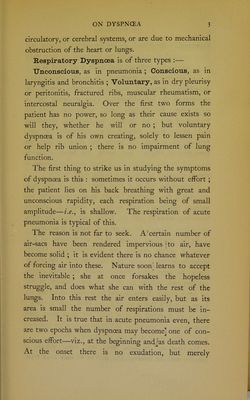
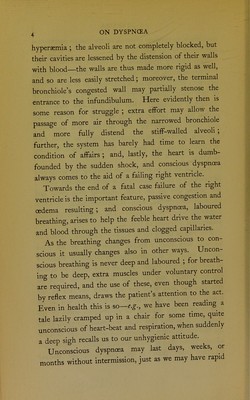
![circulatory, or cerebral systems, or are due to mechanical obstruction of the heart or lungs. Respiratory Dyspnoea is of three types :— Unconscious, as in pneumonia ; Conscious, as in laryngitis and bronchitis ; Voluntary, as in dry pleurisy or peritonitis, fractured ribs, muscular rheumatism, or intercostal neuralgia. Over the first two forms the patient has no power, so long as their cause exists so will they, whether he will or no ; but voluntary dyspnoea is of his own creating, solely to lessen pain or help rib union ; there is no impairment of lung function. The first thing to strike us in studying the symptoms of dyspnoea is this : sometimes it occurs without effort ; the patient lies on his back breathing with great and unconscious rapidity, each respiration being of small amplitude—i.e., is shallow. The respiration of acute pneumonia is typical of this. The reason is not far to seek. A'certain number of air-sacs have been rendered impervious ko air, have become solid ; it is evident there is no chance whatever of forcing air into these. Nature soon learns to accept the inevitable ; she at once forsakes the hopeless struggle, and does what she can with the rest of the lungs. Into this rest the air enters easily, but as its area is small the number of respirations must be in- creased. It is true that in acute pneumonia even, there are two epochs when dyspnoea may become] one of con- scious effort—viz., at the beginning andras death comes. At the onset there is no exudation, but merely](https://iiif.wellcomecollection.org/image/b28034922_0023.jp2/full/800%2C/0/default.jpg)