Volume 1
Universal pronouncing dictionary of biography and mythology / by Joseph Thomas.
- Joseph Thomas
- Date:
- 1911, ©1908
Licence: Public Domain Mark
Credit: Universal pronouncing dictionary of biography and mythology / by Joseph Thomas. Source: Wellcome Collection.
1436/1486 (page 1418)
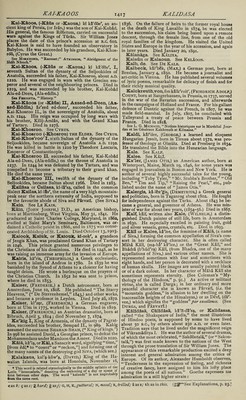
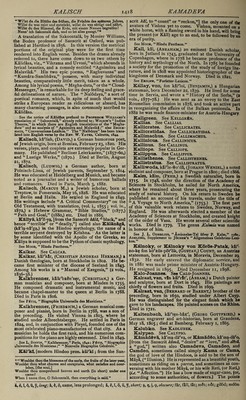
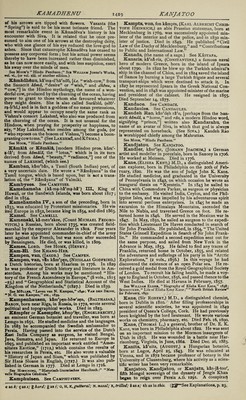
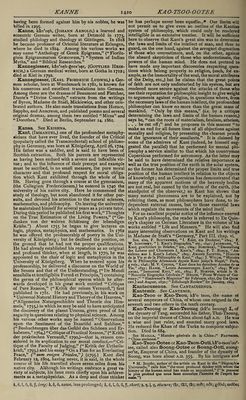
![“ WiMst du die Bliithe des friihen, die Friichte des spSteren Jahres, Willst du was reizt und entziickt, willst du was s'ittigt und n&hrt, Willst du den Himmel, die Erde, mit einem Namen begreifen? Nenn’ ich Sakontald dich, und so ist alles gesagt.”* A translation of the Sakoontala, by Monier Williams, the Boden professor of Sanscrit at Oxford, was pub¬ lished at Hertford in 1856. In this version the metrical portions of the original play were for the first time rendered into English verse. Besides the drama already referred to, there have come down to us two others by Kalidasa, viz., “ Vikrama and Urvasi,” which abounds in lyrical beauties, and a comedy entitled “Agnimitra and Malavikl.” His two epic poems, “ Raghuvansa” and “ Kumlra-Sambhava,” possess, with many individual beauties, comparatively little merit, taken as a whole. Among his lyrical poems, “ Megha-duta,” or the “ Cloud- Messenger,” is remarkable for its deep feeling and grace¬ ful delineations of nature. The “ Nalodaya,” a sort of poetical romance, which, in spite of much that would strike a European reader as ridiculous or absurd, has many charming passages, is also commonly ascribed to Kalidlsa. See the notice of K&lid&sa prefixed to Professor Williams’s translation of “ Sakoontalfi,” already referred to; Wilson’s “ Indian Theatre,” in which there are English translations of the “ Megha- duta” and an analysis of “ Agnimitra and MalavikS also Brock- haus, “ Conversations-Lexikon.” The “ NalSdaya” has been trans¬ lated into English verse by the Rev. W. Yates, Calcutta, 1844. Kalisch, kl'lish, (David,) a German humorous poet, of Jewish origin, born at Breslau, February 23,1820. His verses, plays, and couplets are extremely popular in Ger¬ many. He published “ Berliner Leierkasten,” (1857-60,) and “ Lustige Werke,” (1870.) Died at Berlin, August 21, 1872. Kalisch, (Ludwig,) a German author, born at Polnisch-Lissa, of Jewish parents, September 7, 1814. He was educated at Heidelberg and Munich, and became noted as a journalist and a writer of humorous ballads and romances. Died in Paris, March 3, 1882. Kalisch, (Marcus M.,) a Jewish scholar, born at Treptow, in Pomerania, May 16,1828. He was educated at Berlin an4 Halle. He settled in England in 1849. His writings include “A Critical Commentary” on the Old Testament, with translation, (vol. i., 1855 ; vol. iv., 1872,) a Hebrew Grammar, “Bible Studies,” (1877,) “Path and Goal,” (1880,) etc. Died in 1885. Kclliya, kl'li-ya, [from the Sanscrit k&l&, “ black,” and hence “terrible” or “deadly,”] called also K&lan&g&, (kl'la-nl'ga,) in the Hindoo mythology, the name of a terrible serpent destroyed by Krishna. As the latter is by some identified with the Apollo of the Greeks, so Kaliya is supposed to be the Python of classic mythology. See Moor, “ Hindu Pantheon.” Kalkar. See Calcar. Kalkar, kll'klr, (Christian Andreas Herman,) a Danish theologian, born at Stockholm in 1802. He be¬ came first minister of the diocese of Seeland in 1843. Among his works is a “ Manual of Exegesis,” (2 vols., 1836-38.) Kalkbrenner, kllk'bR§n'n$r, (Christian,) a Ger¬ man musician and composer, born at Minden in 1755. He composed dramatic and instrumental music, and became chapel-master to the queen at Berlin in 1788. Died in Paris in 1806. See F£tis, “Biographie Universelle des Musidens.” Kalkbrenner, (Friedrich,) a German musical com¬ poser and pianist, born in Berlin in 1788, was a son of the preceding. He visited Vienna in 1803, where he studied under Albrechtsberger. He settled in Paris in 1824, and, in conjunction with Pleyel, founded one of the most celebrated piano-manufactories of that city. As a musician he holds the first rank, and his numerous com¬ positions for the piano are highly esteemed. Died in 1849. See L. Boivin, “ Kalkbrenner,” Paris, 1842; FItis, “Biographie Jniverselle des Musidens;” “Nouvelle Biographie G^n^rale.” KcU/kl, [modern Hindoo pron. kul'ki; from the San- * “ Wouldst thou the blossoms of the early, the fruits of the later year, Wouldst thou what charms and enraptures, what satisfies and nour¬ ishes, [the soul,] Wouldst thou comprehend heaven and earth [in short] under one name? When I name thee, O Sakoontala, then everything is said.” scrit kdl, to “ count” or “ reckon,”] the only one of the avatars of Vishnu yet to come. Vishnu, mounted on 9 white horse, with a flaming sword in his hand, will bring the present (or Kali) age to an end, to be followed by an era of purity. See Moor, “ Hindu Pantheon.” Kail, kil, (Abraham,) an eminent Danish scholar, born in Jutland in 1743, graduated at the University of Copenhagen, where in 1778 he became professor of the history and mythology of the North. In 1785 he founded a society for the promotion of the study of foreign lite¬ rature, and in 1808 was appointed historiographer of the kingdoms of Denmark and Norway. Died in 1821. See Erslew, “ Forfatter-Lexicon.” Kdllay, von, fon kll'loi, (Benjamin,) a Hungarian statesman, born December 22, 1839. He lived for some time in Servia, and wrote a “ History of the Serbs,” (2 vols., 1877-78.) He was sent as an envoy to the East Roumelian commission in 1878, and took an active part in reorganizing the affairs of the Balkan peninsula. In 1882 he was made finance-minister for Austria-Hungary. Kallgreen. See Kellgr£n. Kallias. See Callias. Kallicrates. See Callicrates. Kallicratidas. See Callicratidas. . Kallimachus. See Callimachus. Kallinicus. See Callinicus. Kallinus. See Callinus. Kalliope. See Calliope. Kallippus. See Callippus. Kallisthenes. See Callisthenes. Kallistratus. See Callistratus. Kalliwoda, kll'le-fto'dl, (Johann Wenzel,) a noted violinist and composer, born at Prague in 1800; died 1866. Kalm, kllm, (Pehr,) a Swedish naturalist, born in 1715. In 1748, under the direction of the Academy of Sciences in Stockholm, he sailed for North America, where he remained about three years, prosecuting the study of natural history. On his return to Sweden he published an account of his travels, under the title of “A Voyage to North America,” (1753.) The first part of this valuable work relates to Sweden, Norway, and England. He was afterwards elected a member of the Academy of Sciences at Stockholm, and created knight of the order of Vasa. He wrote several other scientific works. Died in 1779. The genus Kalmia was named in honour of him. See J. L. Odhelius, “ Aminnelse-Tal ofver P. Kalm,” 1780; Adelung, Supplement to Tocher’s “ Allgemeines Gelehrten-Lexi- kon.” Kdlnoky, or Kdlnoky von Koros-Patak, kll'« no-ke fon ko'Ros-pot'ok, (Gustav,) Count, an Austrian statesman, born at Lettovitz, in Moravia, December 29, 1832. He early entered the diplomatic service, and in 1881 was made prime minister of Austria-Hungary. He resigned in 1895. Died December II, 1898. Kalo-Joannes. See Calo-Joannes. Kalraat, van, vtn kll'rlt', (Abram,) a Dutch painter and sculptor, born at Dort in 1643. His paintings are chiefly of flowers and fruits. Died in 1699. Kalraat, van, (Bernard or Barent,) brother of the preceding, born in 1650, studied under Albert Cuyp. He was distinguished for the elegant finish which he gave to his landscapes. He painted scenes on the Rhine. Died in 1721. Kaltenbach, kll'ten-blK', (Georg Gottfried,) a German engraver and art-historian, born at Graudenz, May 18, 1805; died at Bamberg, February 1, 1865. Kalubko. See Kadlubek. Kalypso. See Calypso. K&maddva, kl'ma-da'va, or Kdmad@o, kl'ma-da'o, [from the Sanscrit kdmd, “ desire” or “ love,” and d&vd, a “god,”] written also Camadeva, Camadeo, and Camdeo, sometimes called simply Kama or Cama, the god of love of the Hindoos, is said to be the son of Mayl, (“ Illusion.) He is represented as a beautiful youth, sometimes as riding on a parrot, and sometimes as con¬ versing with his mother Maya, or his wife Reti, (or Rati,) (/.*. “ Affection.”) He has a bow made of sugar-cane, (or, according to some authorities, of flowers.) The points](https://iiif.wellcomecollection.org/image/b31359528_0001_1436.jp2/full/800%2C/0/default.jpg)