Arthur Hill Hassall, physician & sanitary reformer : a short history of his work in public hygiene, and of movement against the adulteration of food and drugs / [Edwy Godwin Clayton].
- Clayton, Edwy Godwin.
- Date:
- 1908
Licence: In copyright
Credit: Arthur Hill Hassall, physician & sanitary reformer : a short history of his work in public hygiene, and of movement against the adulteration of food and drugs / [Edwy Godwin Clayton]. Source: Wellcome Collection.
28/176 page 8
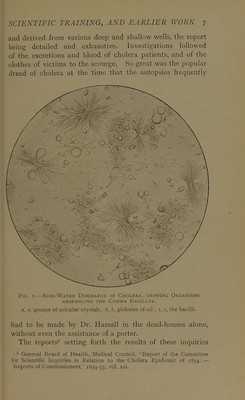
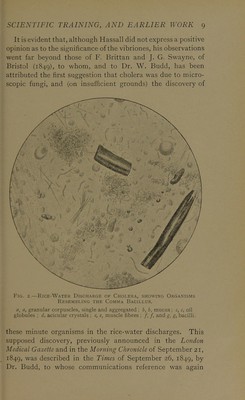
![included some finely executed coloured plates, in several of which (representing the ‘rice-water’ discharges, etc., of cholera patients) were shown, and referred to under the then general name of ‘ vibriones,’among them the curved organism, to which Koch has since (1884) given the name of ‘comma’ bacillus {Spirillum cholera; Asiatices). Two of the plates are here reproduced, by permission of the Controller of His Majesty’s Stationery Office (Figs, i and 2). These investigations were carried out during the year 1854, and the reports were dated, respectively, Decem- ber 21, 1854 (water), and January 22, 1855 (blood and dejecta). Hence it is apparent that the presence of the cholera bacillus was observed, recorded, and figured by Hassall fifty-four years ago.^ The following is a short extract from his report on the rice-water discharges : ‘ We have next to inquire what is the origin or source of these vibriones, and what is their relation to cholera ? . It is perfectly certain that they do frequently gain admission through some of the impure waters consumed, in which I have not unfrequently detected the presence of vibriones, sometimes in considerable numbers. Once introduced into the alimentary canal, they are brought into contact with conditions highly favourable to their develop- ment and propagation, both of which take place with extra- ordinary rapidity. . . . Without, however, at all supposing that there is an essential or primary connection between these vibriones and cholera, their occurrence in such vast numbers in the rice-water discharges of that disease is not without interest and. possibly is of importance.' (The italics are the present writer’s.) ‘... If these vibriones possess any influence on the production of cholera . . .,’ etc. ^ Reviewing Dr. Hassall’s ‘ Narrative of a Busy Life,’ the Dublin Journal of Medical Science (1894, xcvii. 259. 260) said : ‘ He also examined microscopically at this time [1854, E. G. C.] the characteristic discharges in cholera, detected vibriones ” in great abundance, pointed out that the presence of an alkaline fluid was necessary to their development, and thus explained the value of sulphuric acid in checking the diarrhoea of the disease. In this in%'estigation he almost anticipated Koch’s discovery of the specific bacillus of cholera. Fi'om the characters exhibited,” he says, ”... and from their general agreement with Koch’s description, there is not the smallest doubt that the cholera bacillus was present in the discharges in nearly every case, and was first seen by me during the cholera epidemic of 1854.”](https://iiif.wellcomecollection.org/image/b28989995_0028.jp2/full/800%2C/0/default.jpg)