Licence: Public Domain Mark
Credit: Human anatomy (Volume 2). Source: Wellcome Collection.
Provider: This material has been provided by the National Library of Medicine (U.S.), through the Medical Heritage Library. The original may be consulted at the National Library of Medicine (U.S.)
12/684
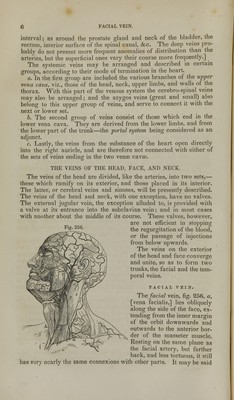
![interval; as around the prostate gland and neck of the bladder, the rectum, interior surface of the spinal canal, &c. The deep veins pro- bably do not present more frequent anomalies of distribution than the arteries, but the superficial ones vary their course more frequently.] The systemic veins may be arranged and described in certain groups, according to their mode of termination in the heart. a. In the first group are included the various branches of the upper vena cava, viz., those of the head, neck, upper limbs, and walls of the thorax. With this part of the venous system the cerebro-spinal veins may also be arranged; and the azygos veins (great and small) also belong to this upper group of veins, and serve to connect it with the next or lower set. b. The second group of veins consist of those which end in the lower vena cava. They are derived from the lower limbs, and from the lower part of the trunk—the portal system being considered as an adjunct. c. Lastly, the veins from the substance of the heart open directly into the right auricle, and are therefore not connected with either of the sets of veins ending in the two venae cavas. THE VEINS OF THE HEAD; FACE, AND NECK. The veins of the head are divided, like the arteries, into two sets,— those which ramify on its exterior, and those placed in its interior. The latter, or cerebral veins and sinuses, will be presently described. The veins of the head and neck, with one exception, have no valves. The external jugular vein, the exception alluded to, is provided with a valve at its entrance into the subclavian vein; and in most cases with another about the middle of its course. These valves, however, are not efficient in stopping the regurgitation of the blood, or the passage of injections from below upwards. The veins on the exterior of the head and face converge and unite, so as to form two trunks, the facial and the tem- poral veins. FACIAL VEIN. The facial vein, fig. 256, a, [vena facialis,] lies obliquely along the side of the face, ex- tending from the inner margin of the orbit downwards and outwards to the anterior bor- der of the masseter muscle. Resting on the same plane as the facial artery, but farther back, and less tortuous, it still has very nearly the same connexions with other parts. It may be said](https://iiif.wellcomecollection.org/image/b21148879_0012.jp2/full/800%2C/0/default.jpg)