Licence: Public Domain Mark
Credit: Human anatomy (Volume 2). Source: Wellcome Collection.
Provider: This material has been provided by the National Library of Medicine (U.S.), through the Medical Heritage Library. The original may be consulted at the National Library of Medicine (U.S.)
18/684
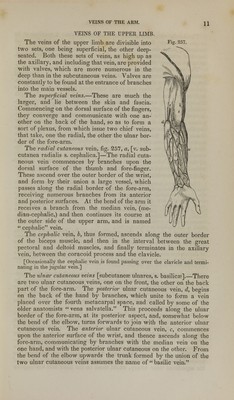
![The basilic vein, e, is usually of considerable size; it receives at its origin a branch from the median vein, g, (median-basilic,) and ascending along the inner border of the biceps muscle, in front of the brachial artery, terminates in one of the venae comites of that vessel, or in the axillary vein, which it chiefly forms. The median cutaneous vein [vena mediana] of the fore-arm, /, results from the union, on the anterior part of the fore-arm, of several branches. It is a short trunk, which serves as a means of communi- cation between the ulnar and radial cutaneous veins on each side, as well as between the superficial and deep veins of the arm. Its length is subject to many varieties; it terminates by dividing into two branches, which diverge upwards from each other. One of these, inclining inwards to join the basilic vein, and thence named median basilic, g, passes in front of the brachial artery, from which it is separated by the fibrous expansion given by the tendon of the biceps muscle to the fascia covering the flexor muscles; it is crossed by branches of the internal cutaneous nerve: the other division, h, (median cephalic,) directed outwards, unites with the cephalic vein, branches of the external cutaneous nerve crossing behind this vein. The upper part of the median vein is also connected with the deep veins by a short branch, which sinks beneath the muscles, and joins the veins accom- panying the brachial artery. [As frequent an arrangement, as the division of the median vein into the median basilic and cephalic, is, for it to join a short trunk, usually varying from three to four inches, crossing over the aponeurotic slip from the tendon of the biceps at the bend of the arm, obliquely from the cephalic to the basilic vein. In such cases the median vein most usually forms a junction with the oblique trunk nearer to the basilic than the cephalic vein, and sometimes the median joins the basilic, and the oblique trunk terminates m it at its junction with the basilic. Occasionally the median vein preserves a distinct course up the arm, and termi- nates in the brachial or axillary veins. In bleeding in the arm, the median basilic vein, or the oblique trunk nearer its junction with the basilic, is most generally chosen, because of its usually greater volume than the median cephalic or the oblique trunk near the cephalic: but the intelligent practitioner should keep it constantly in mind, that the external branch of the internal cutaneous nerve most usually passes over the median basilic or oblique trunk, near the basilic, and is liable to be cut. The external cutaneous nerve passes beneath the median cephalic vein.—J. L.] The deep veins of the upper limb.—The brachial artery, its imme- diate branches, and their several divisions, are each accompanied by two veins, named vence comites. These companion veins lie one on each side of the corresponding artery, and are connected with each other at intervals by short cross branches, which in some places surround the artery. The deep ulnar veins, or the companion veins of the ulnar artery. On examining the hand, it will be found that two small digital veins accompany each digital artery along the side of the phalanges. At the clefts between the fingers, the two small veins from each fino-er are united into single trunks, which continue together alono- the inter- osseous spaces in the palm of the hand, and terminate in the two superficial palmar veins. From this double venous arch two branches proceed at each side of the wrist, the external following the course of the superficial volar artery, whilst those on the inner side accompany](https://iiif.wellcomecollection.org/image/b21148879_0018.jp2/full/800%2C/0/default.jpg)