Volume 1
Biodiversity : the UK Steering Group report.
- Great Britain. Biodiversity Steering Group.
- Date:
- 1995
Licence: Open Government Licence
Credit: Biodiversity : the UK Steering Group report. Source: Wellcome Collection.
23/112 page 19
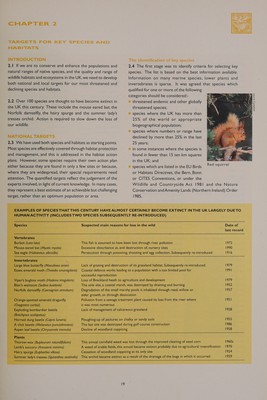
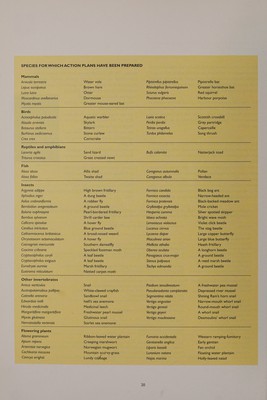
![2.1 If we are to conserve and enhance the populations and natural ranges of native species, and the quality and range of wildlife habitats and ecosystems in the UK, we need to develop both national and local targets for our most threatened and declining species and habitats. 2.2 Over 100 species are thought to have become extinct in the UK this century. These include the mouse eared bat; the Norfolk damselfly, the hairy spurge and the summer lady’s tresses orchid. Action is required to slow down the loss of our wildlife. 2.3 We have used both species and habitats as starting points. Most species are effectively covered through habitat protection and management, and this is addressed in the habitat action plans. However, some species require their own action plan either because they are found in only a few sites or because, where they are widespread, their special requirements need attention. The quantified targets reflect the judgement of the experts involved, in light of current knowledge. In many cases, they represent a best estimate of an achievable but challenging target, rather than an optimum population or area. 2.4 The first stage was to identify criteria for selecting key species. The list is based on the best information available. Information on many marine species, lower plants and invertebrates is sparse. It was agreed that species which qualified for one or more of the following categories should be considered:- * threatened endemic and other globally threatened species; species where the UK has more than 25% of the world or appropriate biogeographical population; » species where numbers or range have declined by more than 25% in the last 25 years; >» in some instances where the species is found in fewer than 15 ten km squares in the UK; and » species which are listed in the EU Birds Red eoiirrel or Habitats Directives, the Bern, Bonn or CITES Conventions, or under the Wildlife and Countryside Act 1981 and the Nature Conservation and Amenity Lands (Northern Ireland) Order 1985. Species Suspected main reasons for loss in the wild Date of last record Vertebrates Burbot (Lota lota) This fish is assumed to have been lost through river pollution 1972 Mouse-eared bat (Myotis myotis) Excessive disturbance at, and destruction of, nursery sites 1990 Sea eagle (Haliaeetus albricilla) Persecution through poisoning, shooting and egg collection. Subsequently re-introduced 1916 Invertebrates = Large blue butterfly (Maculinea arion) Lack of grazing and destruction of its grassland habitat. Subsequently re-introduced. 1979 Essex emerald moth (Thetidia smaragdaria) Coastal defence works leading to a population with a too limited pool for 199] successful reproduction Viper’s bugloss moth (Hadena irregularis) Loss of Breckland heath to agriculture and development 1979 Blair’s wainscot (Sedina buettnei) The sole site, a coastal marsh, was destroyed by draining and burning 1952 Norfolk damselfly (Coenagrion armatum) Degradation of the small marshy pools it inhabited through reed, willow or 1957 alder growth, or through desiccation Orange-spotted emerald dragonfly Pollution from a sewage treatment plant caused its loss from the river where 1951 (Oxygastra curtisii) it Was most numerous Exploding bombardier beetle Lack of management of calcareous grassland 1928 (Brachynus scolopetus) Horned dung beetle (Copris lunaris) Ploughing-up of pastures on chalky or sandy soils 1955 A click beetle (Melanotus punctolineatus) The last site was destroyed during golf course construction 1986 Aspen leaf beetle (Chrysomela tremula) Decline of woodland coppicing 1958 Plants Thorow-wax (Bupleurum rotundifolium) This annual cornfield weed was lost through the improved cleaning of seed corn 1960s Lamb’s succory (Arnoseris minima) Hairy spurge (Euphorbia villosa) jaqdwes aiine]](https://iiif.wellcomecollection.org/image/b32218941_0001_0023.jp2/full/800%2C/0/default.jpg)