Trends in employee health service : Margaret F. McKiever, editor.
- United States. Public Health Service. Division of Occupational Health
- Date:
- 1965]
Licence: Public Domain Mark
Credit: Trends in employee health service : Margaret F. McKiever, editor. Source: Wellcome Collection.
72/124 page 60
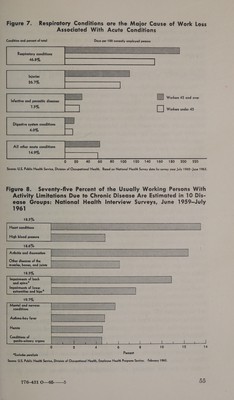
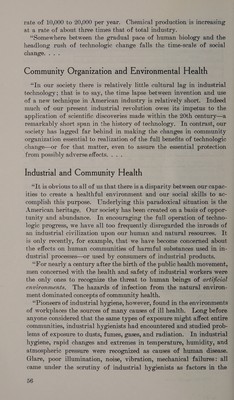
![The year following the publication of Dr. Burney’s article, Congress passed the Community Health Services Act of 1961. This act, which gives financial assistance to programs and facilities providing out-of- hospital services for the chronically 11] and the aged, can have con- siderable significance for both employers and employees. In time, the workplace can become a way in which to reach persons in need of care. The programs receiving assistance under the act are now concentrat- ing on care for those who are chronically ill. Eventually, however, these programs may apply methods of preventing chronic illness, otherwise their task may become overwhelming. Periodic health ap- praisals, health education, and other preventive services will become extremely important and cooperation with the workplace will facili- tate such activities. The emphasis which the act places on restorative services and rehabilitation centers also indicates a great need for pro- moting cooperation between the persons and facilities providing serv- ices and industrial and labor groups within the communities. Economic Considerations Industry and the community have a common interest is preventing illness regardless of cause. “A nation’s productivity—its real wealth—is dependent on the mental, physical, and social health of the population,” Surgeon General Luther Terry recently told the Economic Club of Detroit. “Further, health services are themselves a form of wealth. Health findings and health services seriously af- fect the world of industry and commerce. On the other hand, our health is greatly affected by the way we earn our living and the kind of society in which we live.” Few people, according to Dr. Terry, realize that health is big busi- ness in the United States. “In 1949-50 we spent about $12 billion for health, including personal medical care, construction, and government expenditures. Today, we are spending $33 billion, about 5.4 percent of the gross national product. This represents our dollar effort for health. No one can actually measure cost in human suffering or the total amount of capital gains in the prevention and cure of illness. But as a nation we can think usefully in terms of health assets, health — liabilities, and growth potential.” The control of known industrial health hazards was described by Dr. Terry as a striking economic gain in the health field. The saving in productivity and compensation costs as a result of health and safety services in industry was reported to be incalculable. But the total burden of ill health remains high, Dr. Terry stated. “A number of infectious diseases have virtually disappeared in the United States, and the cost of these diseases has declined correspondingly. In the same period, however, losses of production from other diseases as](https://iiif.wellcomecollection.org/image/b32173635_0072.jp2/full/800%2C/0/default.jpg)
 No text description is available for this image
 No text description is available for this image
 No text description is available for this image