Recollections of John Thurtell, who was executed at Hertford on Friday, the 9th of January, 1824 for murdering Mr. W. Weare. Including various anecdotes, and an account of his demeanour after sentence was passed. Also, the condemned sermon, and a correct view of the execution, taken on the spot by an eminent artist / by Pierce Egan ; being an appendix to his account of the trial.
- Pierce Egan
- Date:
- 1824
Licence: Public Domain Mark
Credit: Recollections of John Thurtell, who was executed at Hertford on Friday, the 9th of January, 1824 for murdering Mr. W. Weare. Including various anecdotes, and an account of his demeanour after sentence was passed. Also, the condemned sermon, and a correct view of the execution, taken on the spot by an eminent artist / by Pierce Egan ; being an appendix to his account of the trial. Source: Wellcome Collection.
48/172 page 38
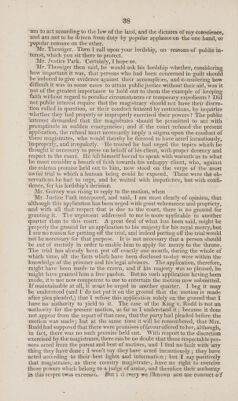
![“am _to act according to the law of the land, and the dictates of my conscience, “and am not to be driven from duty by popular applause on ‘the one hand, or ‘popular censure on the other. Mr. Thessiger. Then I call upon your lordship, on ‘reasons of public in- ‘terest, which you sit'there to protect. | Mr. Justice Park. Certainly, I hope’so. Mr. Thessiger then said, he would ask his lordship whether, considering how important it was, that persons who had been concerned in guilt should be induced to give evidence against their accomplices, and considering how difficult it was in some cases to attain public justice without their aid, was it ‘hot of the greatest importance to hold out to them the example of keeping faith without regard to peculiar circumstances or temporary expedients? Did not public interest require that the magistracy should not have their discre- tion called in question, or their conduct fettered by restrictions, by inquiries whether they had properly or improperly exercised their powers? The public interest demanded that the magistrates should be permitted to act with promptitude in sudden emergencies; and if the court ‘refused the present application, the refusal must necessarily imply a stigma upon the conduct of these magistrates, who would thereby be deemed to have acted incautiously, improperly, and irregularly. He trusted he had urged the topics which he thought it necessary to press on behalf of his client, with proper decency and respect to the court. He felt himself bound to speak with warmth ‘as to what he must consider a breach of faith towards his unhappy client, who, against the solemn promise held out to him, now stood on the verge of the most awful trial te which a human being could be exposed. These were the ob- ‘servations he had to urge, and he waited with impatience, but with confi- ‘dence, ter his lordship’s decision. Mr. Gurney was rising to reply to the motion, when Mr. Justice Park interposed, and said, I am most clearly of opinion, that although this application has been urged with great vehemence and propriety, and with all that respect that is due to the court, there is no ground for granting it. The argument addressed to me is more-applicable in another quarter than to this court. A great deal of what has been said, might be properly the ground for an application to his majesty for his royal mercy, but I see no reason for putting off the trial, and indeed putting off the trial would not be necessary for that purpose. It is not necessary that a person should be out of custody in order to enable him to apply for mercy to the throne. The trial has already been put off exactly one month, during the whole of which ‘time, all the facts which have been disclosed to-day were within the knowledge of the prisoner and his legal advisers. The application, therefore, might have been made to the crown, and if his majesty was so pleased, he ‘might have granted him a free pardon. Butno such application having been made, itis not now competent to me to entertain the motion now submitted. If maintainable at all, it must be urged in another quarter. I beg it may ‘be understood (and I do not put it on the ground that the motion is made after plea pleaded,) that I refuse this application solely on the ground that I have no authority to yield to it. The case of the King v. Rudd is not an authority for the present motion, as far as I understand it ; because it does not appear from the report of that case, that the party had pleaded before the motion was made; but at the same time it will be remembered, that Mrs. Rudd:had supposed that there were promises of favour offered to her, although, in fact, there was no such promise held out. With respect to the discretion exercised by the magistrates, there can be no doubt that those respectable per- sons acted from the purest and best of motives, and I find no fault with any thing they have done; I won’t say they have acted incautiously ; they have acted according to their best lights and information; but I say positively that magistrates, as these country magistrates, have no right to exercise those powers which belong to a judge of assize, and therefore their authority 34 this respec twas exceeaea. Buti i2 every we J]known ana tne conauct of](https://iiif.wellcomecollection.org/image/b33287442_0048.jp2/full/800%2C/0/default.jpg)