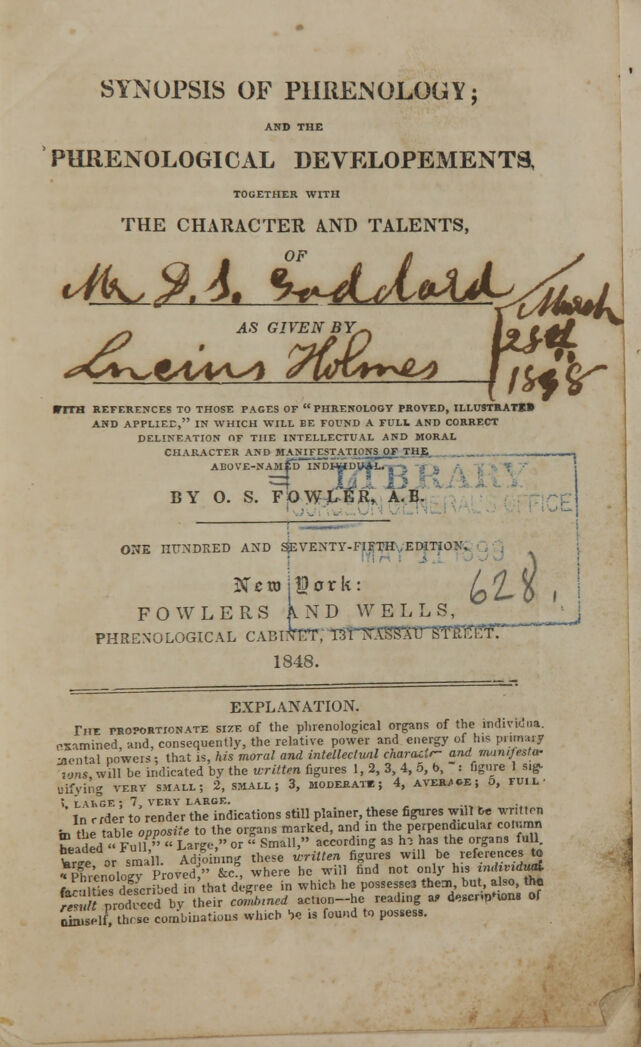
Synopsis of phrenology and the phrenological developments : together with the character and talents of [blank] as given by [blank] : with reference to those pages of "Phrenology proved, illiustrated, and applied," in which will be found a full and correct delineation of the intellectual and moral character and manifestations of the above-named individual / by O.S. Fowler.
- Orson S. Fowler
- Date:
- 1848
Licence: Public Domain Mark
Credit: Synopsis of phrenology and the phrenological developments : together with the character and talents of [blank] as given by [blank] : with reference to those pages of "Phrenology proved, illiustrated, and applied," in which will be found a full and correct delineation of the intellectual and moral character and manifestations of the above-named individual / by O.S. Fowler. Source: Wellcome Collection.
Provider: This material has been provided by the National Library of Medicine (U.S.), through the Medical Heritage Library. The original may be consulted at the National Library of Medicine (U.S.)
4/24
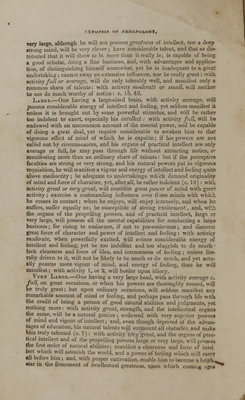
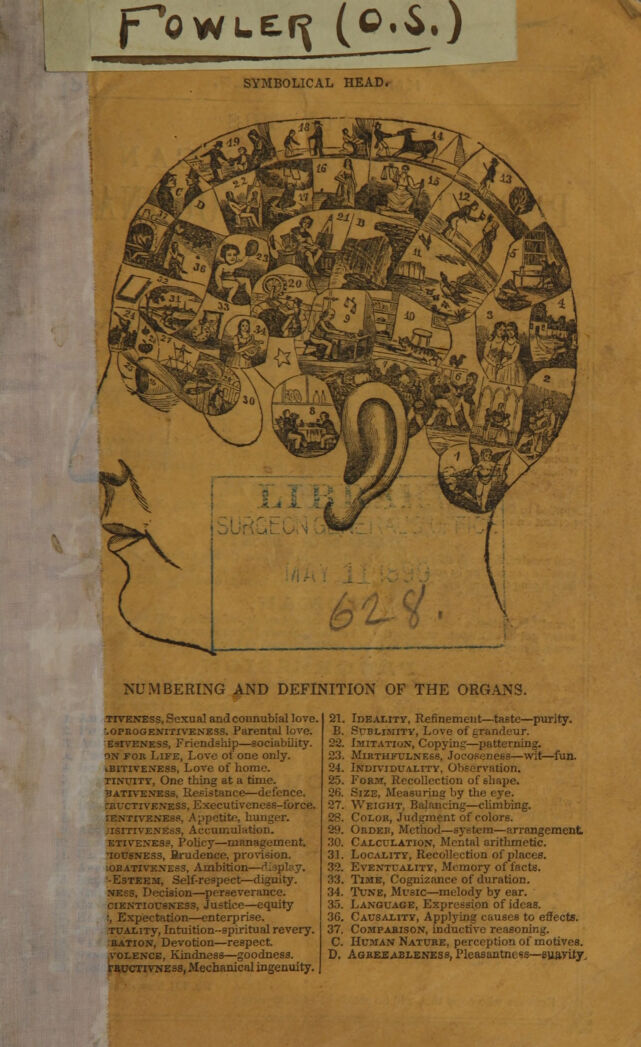
![Phrenologt—Points out tnose onntAions and relations vmich exist between the conditions and dcvelopements of the brain, and, <hc mani- festations of the mini), discovering each from an observation of the other. Its one distinctive characteristic doctrine is, that each class of the mental functions is manifested by means of » given portion of the brain, called an organ, the size of which is the measure of the power of function. Thus the benevolent feeling is manifested and indicated- by means of brain in the frontal part of the top of the head, (see cuts) and in proportion to the developementof brain here, will be ones spontaneous flow of kind, obligirg feeling; and so of every other quality of mind. I. The brain is the organ of the mind, or the physical instrument of thought and feeling. , powers \V. Firi %MH \ and perfection of the mental operations than could be attained by the mind'j V^k <beingla. single power. • ' thing fit the sane time, but if* it be a compound of sev^l pov^ers,^each ) 3fr could Be in simuitanebu*action. ©urowntoriscioCsness^sUresusTnatwe V ^ can attend to more than one thing at a time—that we can be looking and thinking, walking and talking, feeling and acting, &c, all simultaneously. Third. Insane persons are often deranged only upon a single subject, whilst they are sane upon every othei. Now were the mind a single power, and the brain a unity, sanity upon one subject, and insanity upon another, could not co-exist; whereas, were it a plurality of powers, and the brain, of organs, a given organ, and with it its power, might be deranged, whilst the others remained in a healthy state, which coincides with facts. III. The brain consists of as many different portions called or- gans, as the mind does of faculties. If the brain be a unity, then the pathological or diseased condition of any portion of it must affect the brain as a ivholc, and prove injurious to the mind as a whole, affecting equally its every function and operation but in case the brain is an assemblage of parts or organs, it is plain that the injury of one of them will affect that particular class of mental func tions which is exercised by it, and that only. Now this is the form which insanity generally assumes. This class of facts is of that positive, ad hominen, conclusive character which will at once establish or refute phren- ology, and the force of which no reflecting mind can gainsay or resist. IV. 77<e faculties are possessed originally in different degrees of power by different individuals, and also by the same individual. V. Other conditions being equal, the size of the brain, and of each vrgan, is the measure of their poiver of function. This principle of increase by exorcise, and decrease by inaction, is familiar in its application to the hands of the laborer, sailor, &c. to the foot of the expert dancer and the pedestrian, to the breast of the rower, th right hand compared with the left, &c. And since the brain is governed by this same physiological law, why should not its effect be the same upon the organs of the brain ] It is for our opponents to show that this is not the case, especially since there are so many facts establishing this point. Entered according to Act of Congress, in the year 1838, by O. S. Fow lkr, in tho Clerk's Office of the Eastern District of Pennsylvania](https://iiif.wellcomecollection.org/image/b21120493_0004.jp2/full/800%2C/0/default.jpg)