Pathogenic micro-organisms : including bacteria and Protozoa; a practical manual for students, physicians and health officers / by William Hallock Park ; assisted by Anna W. Williams.
- William Hallock Park
- Date:
- 1908
Licence: In copyright
Credit: Pathogenic micro-organisms : including bacteria and Protozoa; a practical manual for students, physicians and health officers / by William Hallock Park ; assisted by Anna W. Williams. Source: Wellcome Collection.
24/712 page 6
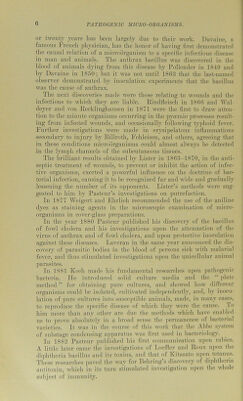
![or twenty years has Ijeen largely due to tlieir work. Davaine, a famous French physician, has the honor of having first demonstrate^] the eansal relation of a microorganism to a specihc infections disease in man and animals. The anthrax hacillns was discovered in the blood of animals dying from this disease by Pollender in 1849 and by Davaine in 1850; but it was not nntil 1863 that the last-named observer demonstrated by inoculation experiments that the bacillus was the cause of anthrax. The next discoveries made were those relating to wounds and the infections to which they are liable. Rindfleiseh in 1866 and IVal- deyer and von Recklinghansen in 1871 were the first to draw atten- tion to the ininnte organisms occurring in the pysemic processes result- ing from infected wounds, and occasionally following typhoid fever. Further investigations were made in erysipelatous inflammations secondary to injury by Billroth, Fehleisen, and others, agreeing that in these conditions microorganisms coidd almost always he detected in the lymph channels of the subcutaneous tissues. The brilliant results obtained by Lister in 1863—1870, in the anti- septic treatment of wounds, to prevent or inhibit the action of infec- tive organisms, exerted a powerful influence on the doctrine of bac- terial infection, causing it to he recognized far and wide and gradually lessening the number of its opponents. Lister’s methods were sug- gested to him by Pasteur’s investigations on putrefaction. In 1877 Weigert and Ehrlich recommended the nse of the aniline dyes as staining agents in the microscopic examination of micro- organisms in cover-glass preparations. In the year 1880 Pastenr published his discovery of the bacillus of fowl cholera and his investigations ixpon the attennation of the virus of anthrax and of fowl cholera, and upon protective inoculation against these diseases. Laveran in the same year announced the dis- covery of parasitic bodies in the blood of persons sick with malarial fever, and thus stimulated investigations upon the nnicellnlar animal parasites. In 1881 Koch made his fundamental researches u]X>n pathogenic bacteria. He. introduced solid culture media and the ‘‘ plate method ” for obtaining pure cultures, and showed how different organisms could he isolated, cultivated independently, and, by inocu- lation of pure cultures into susceptible animals, made, in many cases, to reproduce the specific disease of which they were the cause. To him more than any other are due the methods which have enabled ns to prove absolutely in a broad sense the permanence of bacterial varieties. It was in the course of this work that the .Vhhc system of snhstage condensing apiiaratns was first used in bacteriology. In 1882 Pasteur -|)uhlished his first communication u]xm rabies. A little later came the investigations of Loefller and Bonx ipwn the di])htheria bacillus and its toxins, and that of Kitasato tpwn fefanns. '^rhese rcseai’ch(’s ]iavcd the way for Behring s discovery of di]'>htheria antitoxin, which in its turn stimulated investigation ipion the vhole sid)ject of immunity.](https://iiif.wellcomecollection.org/image/b28137541_0024.jp2/full/800%2C/0/default.jpg)