Pathogenic micro-organisms : including bacteria and Protozoa; a practical manual for students, physicians and health officers / by William Hallock Park ; assisted by Anna W. Williams.
- William Hallock Park
- Date:
- 1908
Licence: In copyright
Credit: Pathogenic micro-organisms : including bacteria and Protozoa; a practical manual for students, physicians and health officers / by William Hallock Park ; assisted by Anna W. Williams. Source: Wellcome Collection.
28/712 page 10
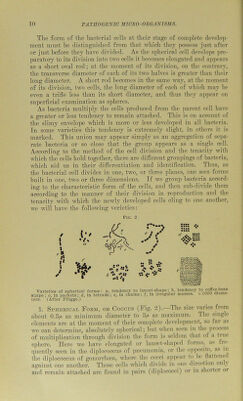
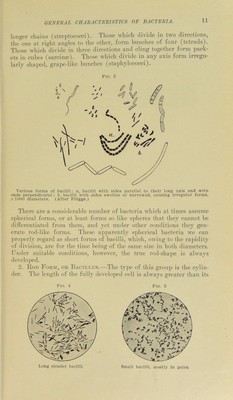
![The form of the hacterial cells at their stage of complete develop- ment must he distinguished from that which they possess just after or just before they have divided. As the spherical cell develops pre- paratory to its division into two cells it becomes elongated and appears as a short oval rod; at the moment of its division, on the contrary, the transverse diameter of each of its two halves is greater than their long diameter. A short rod becomes in the same way, at the moment of its division, two cells, the long diameter of each of which may he even a trifle less than its short diameter, and thus they appear on superflcial examination as spheres. As bacteria multiply the cells produced from the parent cell have a greater or less tendency to remain attached. This is on account of the slimy envelope which is more or less developed in all bacteria. In some varieties this tendency is extremely slight, in others it is marked. This union may appear simply as an aggregation of sepa- rate bacteria or so close that the group appears as a single cell. According to the method of the cell division and the tenacity with which the cells hold together, there are different groupings of bacteria, which aid us in their differentiation and identiflcation. Thus, as the bacterial cell divides in one, two, or three planes, one sees forms built in one, two or three dimensions. If we group bacteria accord- ing to the characteristic form of the cells, and then sub-divide them according to the manner of their division in reproduction and the tenacity with which the newly developed cells cling to one another, we will have the following verieties: Fig. 2 b' /• •*'4' // •• y fv- '• I * / *0 0, 4*S e J * 7 « :: ^ •/. *5* •••• «••• •••• Varieties of spherical forms : a, tendency to lancet-shape; b, tendency shape; c, in packets; d, in tetrads; Cj in chains; f, in irregular masses, ters. (After Fliigge.) to coffee-bean X 1000 diame- 1. SpHEEiCAn Form, or Coccus (Fig- 2).—The size varies from about 0.3/1 as minimum diameter to 3/^ as maximum. The single elements are at the moment of their complete development, so far as we can determine, absolutely spherical; but wlien seen in the piocess of multiplication through division the form is seldom lhat of a true sphere. Here we have elongated or lauafl-shaiic'd forms, as fre- quently seen in the diploeocciis of pmnimouia, or the op]'»osite, as in the diplococcus of gonorrhoea, where the cocci appear to H flattene against one another. Those cells which divide iu one direction on i and remain attached are found in pairs (diplococci) or in shorter or](https://iiif.wellcomecollection.org/image/b28137541_0028.jp2/full/800%2C/0/default.jpg)