Pathogenic micro-organisms : including bacteria and Protozoa; a practical manual for students, physicians and health officers / by William Hallock Park ; assisted by Anna W. Williams.
- William Hallock Park
- Date:
- 1908
Licence: In copyright
Credit: Pathogenic micro-organisms : including bacteria and Protozoa; a practical manual for students, physicians and health officers / by William Hallock Park ; assisted by Anna W. Williams. Source: Wellcome Collection.
30/712 page 12
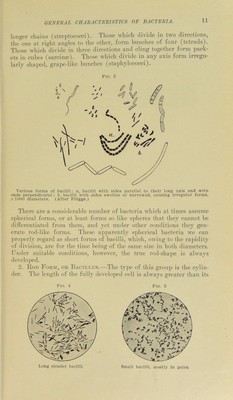
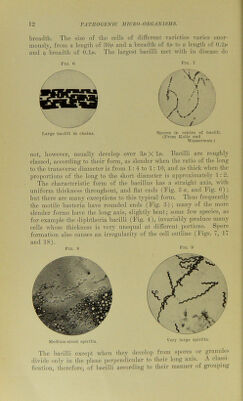
![breadth. The size of the cells of different varieties varies enor- mously, from a length of 30/x and a breadth of V t/> a length of 0.2/x and g breadth of 6.1/^. The largest bacilli met with in disease do Fig. 6 Large bacilli in chains. Fig. 7 Spores in centre of bacilli. (From Kolle and Wasserman.) not, however, usually develop over 3/a X 1/^- Bacilli are roughly classed, according to their form, as slender when the ratio of the long to the transverse diameter is from 1: 4 to 1: 10, and as thick when tlie j^roportions of the long to the short diameter is approximately 1:2. The characteristic form of the bacillus has a straight axis, with uniform thickness throughout, and flat ends (Fig. 3 a, and Fig. 0) ; but there are many exceptions to this typical form. Thus frequently the motile bacteria have rounded ends (Fig. 3) ; many of the more slender forms have the long axis, slightly bent; some few species, as for example the diphtheria bacilli (Fig. 4), invariably produce many cells whose thickness is very unequal at different portions. Spore formation also causes an irregailarity of the cell outline (Figs. (, 17 and 18). Fig. S Fig. 9 Medium-sized spirilla. Ver.v large spirilla. dive bacilli excc]it when they develop from sjxu’es^ or gianuleb divide only in the ])lane peiqiendicular to their long axis. A classi- fication, therefore, of bacilli according to their manner of giouping](https://iiif.wellcomecollection.org/image/b28137541_0030.jp2/full/800%2C/0/default.jpg)