A manual of bandaging : adapted for self-instruction / by C. Henri Leonard.
- Leonard, C. Henri (Charles Henri), 1850-1925
- Date:
- [1884], [©1884]
Licence: Public Domain Mark
Credit: A manual of bandaging : adapted for self-instruction / by C. Henri Leonard. Source: Wellcome Collection.
Provider: This material has been provided by the Francis A. Countway Library of Medicine, through the Medical Heritage Library. The original may be consulted at the Francis A. Countway Library of Medicine, Harvard Medical School.
30/172 page 24
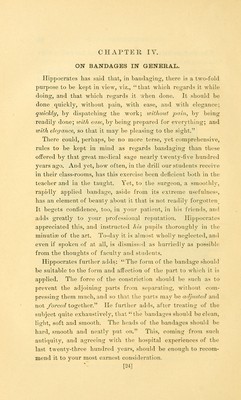
![ON BANDAGES IN GENERAL. Hippocrates has said tliat, in bandaging, there is a two-fold purpose to be kept in view, viz., that which regards it while doing, and that which regards it vhen done. It should be done quickly, without pain, with ease, and with elegance; quickly, by dispatching the work; loithout pain, by being readily done; with ease, by being prepared for everything; and with elegance, so that it may be pleasing to the sight. There could, perhaps, be no more terse, yet comprehensive, rules to be kept in mind as regards bandaging than these offered by that great medical sage nearly twenty-five hundred years ago. And yet, how often, in the drill our students receive in their class-rooms, has this exercise been deficient both in the teacher and in the taught. Yet, to the surgeon, a smoothly, rapidly aj^plied bandage, aside from its extreme usefulness, has an element of beauty about it that is not readily forgotten^ It begets confidence, too, in your patient, in his friends, and adds greatly to your ^professional reputation. Hippocrates appreciated this, and instructed his pupils thoroughly in the minutioe of the art. To-day it is almost wholly neglected, an«l even if spoken of at all, is dismissed as hurriedly as possible' from the thoughts of faculty and stiulents, Hippocrates further adds: The form of the bandage should be suitable to the form and affection of the part to which it is applied. The force of the constriction should be such as to prevent the adjoining parts from separating, without com- pressing them much, and so that the parts may be adjusted and not forced together. He further adds, after treating of the subject quite exhaustively, that the bandages should be clean, light, soft and smooth. The heads of the bandages should be hard, smooth and neatly put on. This, coming from such antiquity, and agreeing with the hospital experiences of the last twenty-three hundred years, should be enough to recom- mend it to your most earnest consideration. [24]](https://iiif.wellcomecollection.org/image/b21064076_0030.jp2/full/800%2C/0/default.jpg)