A new, complete, and universal collection of authentic and entertaining voyages and travels to all parts of the world : containing (among other voyages and travels undertaken for discovery, conquest, settlement, or the opening of trade) complete narratives of the following most important journals ... and including a new ... and complete historical account of the whole of Captain Cook's first, second, third and last voyages ... describing in the most accurate manner, upon an entire new and interesting plan, every place worthy of notice in Europe, Asia, Africa and America / the whole compiled from the original journals of the respective voyagers, &c. and now published under the immediate direction of Philip Wilson, assisted by George William Anderson and William Henry Portlock. Revised, corrected and improved by William Henry Portlock.
- Wilson, Philip (Philip G.)
- Date:
- [between 1790 and 1799]
Licence: Public Domain Mark
Credit: A new, complete, and universal collection of authentic and entertaining voyages and travels to all parts of the world : containing (among other voyages and travels undertaken for discovery, conquest, settlement, or the opening of trade) complete narratives of the following most important journals ... and including a new ... and complete historical account of the whole of Captain Cook's first, second, third and last voyages ... describing in the most accurate manner, upon an entire new and interesting plan, every place worthy of notice in Europe, Asia, Africa and America / the whole compiled from the original journals of the respective voyagers, &c. and now published under the immediate direction of Philip Wilson, assisted by George William Anderson and William Henry Portlock. Revised, corrected and improved by William Henry Portlock. Source: Wellcome Collection.
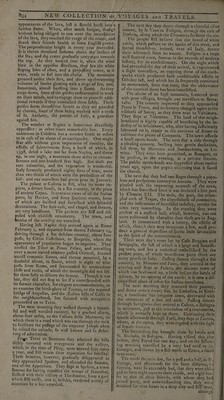
![and TRAVELS. appearances of the lava, left it fhould burft into a fudden flame. When, after much fatigue, though without being obliged to run over the incruftation of the lava, they reached the verge of the crater, and drank their friends health in fome Englifli porter. The perpendicular height is every year increafed. It is eleven thoufand fathoms above the furface of the fea; and thq crater gradually converges towards the top. As they looked into it, when the wind blew in the oppofite direfilion, they faw the white Hoping fides of allies, and a projecting tower, as it were, ready to fall into the chafni. The mountain groaned under their feet, and threw up threatening volumes of fmoke glowing with a tinge of fire, and, fometimes, almoft burfting into a flame. As they crept down, fome of the guides endeavoured to work on their minds, and to engage them to promife addi¬ tional rewards if they conducted them fafely. Thefe guides deem themfelves fecure as they are guarded by charms, fome of them being marked with a crofs of St. Anthony, the patron of Jtalv, a guardian againft fire. The weather at Naples is fometimes dreadfully oppreflive : at other times remarkably fine. Every nobleman in Calabria has a wooden houfe to refort to in cafe of an alarm of an earthquake. One might fear alfo without great imputation of timidity, the effeCts of fubterranean fires, a burft of which, in 1538, dried a lake not far from Naples, and threw up, in one night, a mountain three miles in circum¬ ference arid one hundred feet high. But thefe are rare calamities, and the vegetation is wonderful. Italy formerly produced eighty forts of wine, more than two thirds of which were the production of the foil: and our travellers had green peas in January. The palace at Caferta is {till, what its name im¬ ports, a dreary houfe, in a flat country, in the plain of ancient Capua. It contains views of all the Italian ports, by Racket, and fome fpacious rooms, fome of which are finilhed and furnifhed with fplendid decorations. The flair-cafe, and chapel, and theatre, are v6ry handfome. The gardens are ftiff and dif- pofed with childifh ornaments. The town, and houfes of the nobility are wretched. Having left Naples they arrived again at Rome February 1, and departed from thence February 15, driving through a flat defolate country, about four pofts, by Civita Caftellana, to Borgetto, where the appearance of population began to improve. They eroded the Tiber at Ponte Iclice, and travelling over a more varied country palled Otricoli, fituated kmidft romantic feenes, and thence mounted, by a doubtful afeent, to Narni, which is eight or nine polls fiom Rome, and furrounded by tremendous cliffs and rocks, of which the moonlight did not fuf- rer them fully to difeern the beauty. Though it was late, they did not flop to fee if it correfponded with its former charaCler, for elegant accommodations, or to examine the birth-place of Tacitus, or the reputed bridge of Auguftus, and the yEolian hills of Cadis in the neighbourhood, but fatiated with antiquities proceeded on to Terni. Tne next morning they walked through a beauti¬ ful and well wooded country, by a gradual afeent, about four miles, to the Calcata della Marmore, to which there is a road which was cut through the rock to facilitate the paffage of the emperor Jofeph when he vifited the cafcade, fo well known and fo defer- ving of admiration. . Frqpi Terni to Strettura they admired the hills richly covered with evergreens and the valleys, which, in the time of Pliny, were mowed four times a year, and ftill retain their reputation for fertility. Thefe beauties, however, gradually difappeared as they approached Spoleto, and afeended the Somma. one of the Appenines. They flept at Spoleto, a town famous for having repulfed the troops of Hannibal, flu filed with their viflory at Thrafimene, from a gate which ftill exifts, and is, befides, rendered worthy of 'attention by a fine aquedufit. The next day they drove through a cheerful olive county, by le Yene to Foligno, through the vale of Umbria, along which the Clitumnus frefhens the air. The people ftill believe that the breed of white cattle, which pafture on the banks of this river, and fpread themfelves, indeed, over all Italy, derive their whitenefs from its waters. Foligno is a large well fituated town, famous in the records of modern hiftory, for its confeftionary. On the night which had preceded the day of their arrival, it experienced a flight conculjion, an expiring throe of the earth¬ quake which produced fuch confiderable effefls in Oftober laft, and which has fo frequently continued its movements, fince that time, that the obfervante of the carnival there has been interdicted. I he afeent of an high mountain, fcattered over with poor villages, brought our travellers to Serra- valle. I he country improved as they approached Pp.nte le ] rave, and its Icenery changed again to the wildnefs of Savoy, as they drew near to Valcimara. I hey flept at 1 olentino. T he land-of this neigh¬ bourhood is highly capable of benefiting by the in- duftry ol its inhabitants, who, after having fufficiently laboured on it, repair to the environs of Rome to cultivate the plains of Campania. The town affords a final! opera-houfe. The next day a ride through a pleafing country, fwelling into gentle declivities, led them, by Macerata and Sambuchetto, to Lo- retto. I hey were here permitted, as ftrangers, to be prefent, in the evening, at a private theatre. 1 he public opera-houfe was fuppreffed about twelve years ago, upon the pope’s obferving that it faced the church. 1 he next day they had two ftages through a popu¬ lous and profperous country to Ancona. They were pleafed with the improving neatnefs of the town, which has flourifhed fince it was declared a free port by Clement XII. The mole, the port, the trium¬ phal arch of Trajan, the cheerfulnefs of commerce, and the indications offuccefsful induftry, render the town very interefting. In the evening they were prefent at a mafked ball, which, however, was not more enlivened by charaCler than thofe are in Eng¬ land. It commenced with a lottery, the eff'eCls of which, though they may intoxicate a few, muft pro¬ duce a general depreftion of fpirits little favourable • to the fpirit of the entertainment. 1 heir next day’s route lay by Cafe Brugiate ar.d Senigaglia, the laft of which is a large and flourifti- ing town, and has a cathedral embellifticd by the prelent pope, of whofe munificent piety there are many proofs in Italy. Faffing thence through a flat country, by Marotto and Fano, they arrived in the evening and flept at Pefaro, the ancient town of which was fwallowed up, a little before the battle of ACliurn, by an opening of the earth: it is now a dif- tinguifhed place of refort for Italian merchants. I he next morning they renewed their journey, and drove over a dreary flat, by Catholica, to Rimi¬ ni, a handfome but irregular town, decorated with the ornament of a fine old arch. Faffing thence through Savignano they arrived at Cafena, a Bologna in miniature, juft at the conclufion of a tournament, which is annually kept up there. Continuing their courle afterwards through Forli, they flept at Faenza, where, at the opera, thev were regaled with the fight of female dancers. I he lucceeding day brought them by Imola and St. Nicholo, to Bologna. Having vifited this city before, they flayed but one day; and on the follow¬ ing morning travelled by a very bad road to St. Georgio, and thence’ by a ftill worfe to Cento, a (mall neat- town. I he roads the next day, for a poll and a half, to Sr. Ge.orge, and afterwards for the fame dillance, to herrara, were fo execrably bad, that they were obli¬ ged to have eight oxen to their chaife, and eight hor- les to that, of their friends, with whom they had joined party, and notwithftanding this, they were detained for nine hours in a deep clay and ftiff mud. through](https://iiif.wellcomecollection.org/image/b3044990x_1264.jp2/full/800%2C/0/default.jpg)