A treatise on the diseases of the eye.
- Wells, J. Soelberg (John Soelberg), -1879.
- Date:
- 1873
Licence: Public Domain Mark
Credit: A treatise on the diseases of the eye. Source: Wellcome Collection.
Provider: This material has been provided by the Gerstein Science Information Centre at the University of Toronto, through the Medical Heritage Library. The original may be consulted at the Gerstein Science Information Centre, University of Toronto.
36/868 page 30
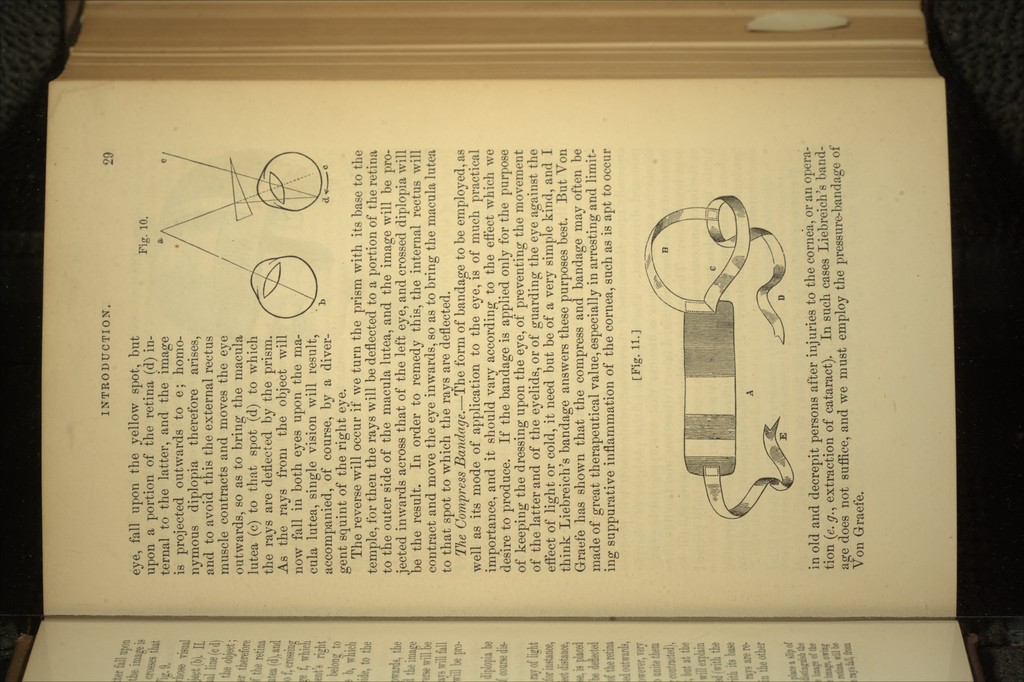
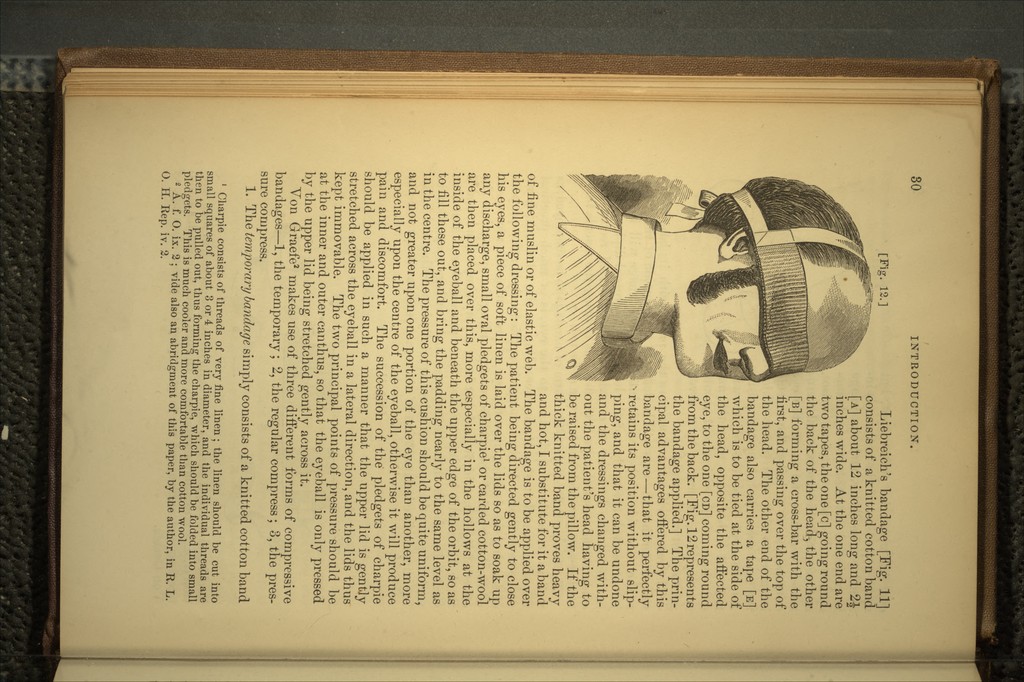
![[Fig. 12.] Liebreich's bandage [Fig. 11] consists of a knitted cotton band [A] about 12 inches long and 2J inches wide. At the one end are two tapes, the one [c] going round the back of the head, the other [B] forming a cross-bar with the first, and passing over the top of the head. The other end of the bandage also carries a tape [E] which is to be tied at the side of the head, opposite the affected eye, to the one [CD] coming round from the back. [Fig. 12 represents the bandage applied.] The prin- cipal advantages offered by this bandage are—that it perfectly • retains its position without slip- ping, and that it can be undone and the dressings changed with- out the patient's head having to be raised from the pillow. If the thick knitted band proves heavy and hot, I substitute for it a band of fine muslin or of elastic web. The bandage is to be applied over the following dressing: The patient being directed gently to close his eyes, a piece of soft linen is laid over the lids so as to soak up any discharge, small oval pledgets of charpie1 or carded cotton-wool are then placed over this, more especially in the hollows at the inside of the eyeball and beneath the upper edge of the orbit, so as to fill these out, and bring the padding nearly to the same level as in the centre. The pressure of this cushion should be quite uniform, and not greater upon one portion of the eye than another, more especially upon the centre of the eyeball, otherwise it will produce pain and discomfort. The succession of the pledgets of charpie should be applied in such a manner that the upper lid is gently stretched across the eyeball in a lateral direction, and the lids thus kept immovable. The two principal points of pressure should be at the inner and outer canthus, so that the eyeball is only pressed by the upper lid being stretched gently across it. Von Graefe2 makes use of three different forms of compressive bandages—1, the temporary ; 2, the regular compress ; 3, the pres- sure compress. 1. The temporary bandage simply consists of a knitted cotton band 1 Charpie consists of threads of very fine linen ; the linen should be cut into small squares of about 3 or 4 inches in diameter, and the individual threads are then to be pulled out, thus forming the charpie, -which should be folded into small pledgets. This is much cooler and more comfortable than cotton wool. 2 A. f. O. ix. 2 ; vide also an abridgment of this paper, by the author, in R. L. O. H. Rep. iv. 2.](https://iiif.wellcomecollection.org/image/b20996408_0036.jp2/full/800%2C/0/default.jpg)
 No text description is available for this image
 No text description is available for this image
 No text description is available for this image