A treatise on the diseases of the eye.
- Wells, J. Soelberg (John Soelberg), -1879.
- Date:
- 1873
Licence: Public Domain Mark
Credit: A treatise on the diseases of the eye. Source: Wellcome Collection.
Provider: This material has been provided by the Gerstein Science Information Centre at the University of Toronto, through the Medical Heritage Library. The original may be consulted at the Gerstein Science Information Centre, University of Toronto.
69/868 page 63
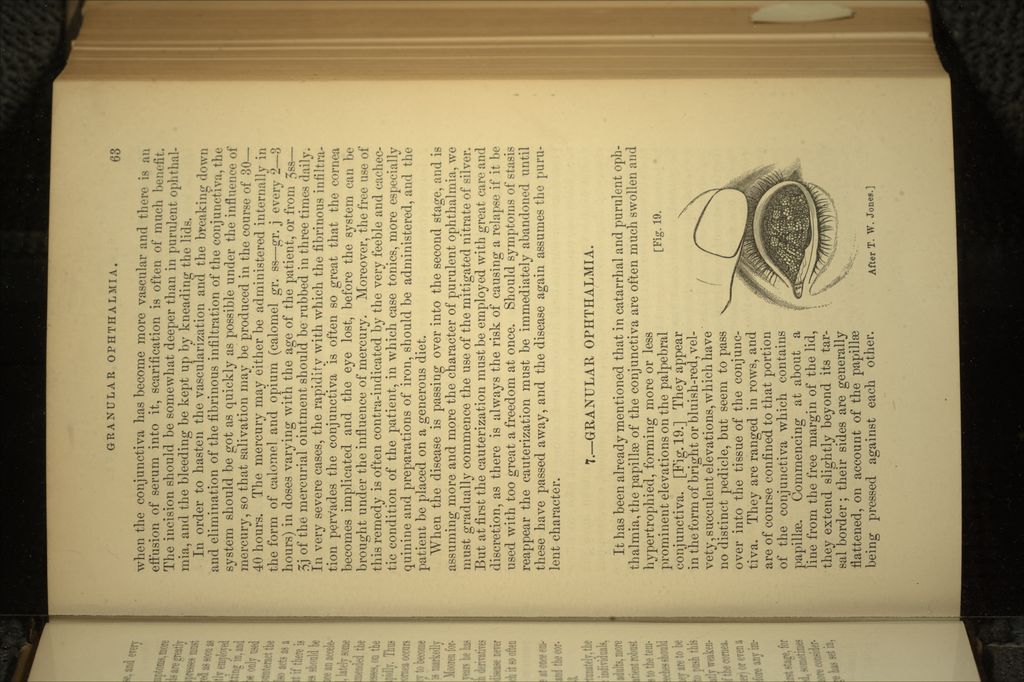
![when the conjunctiva has become more vascular and there is an effusion of serum into it, scarification is often of much benefit The incision should be somewhat deeper than in purulent ophthal- mia, and the bleeding be kept up by kneading the lids. In order to hasten the vascularization and the breaking down and elimination of the fibrinous infiltration of the conjunctiva, the system should be got as quickly as possible under the influence of mercury, so that salivation may be produced in the course of 30 40 hours. The mercury may either be administered internally in the form of calomel and opium (calomel gr. ss—gr. j every 2—3 hours) in doses varying with the age of the patient, or from 3ss— 3j of the mercurial ointment should be rubbed in three times daily. In very severe cases, the rapidity with which the fibrinous infiltra- tion pervades the conjunctiva is often so great that the cornea becomes implicated and the eye lost, before the system can be brought under the influence of mercury. Moreover, the free use of this remedy is often contra-indicated by the very feeble and cachec- tic condition of the patient, in which case tonics, more especially quinine and preparations of iron, should be administered, and the patient be placed on a generous diet. When the disease is passing over into the second stage, and is assuming more and more the character of purulent ophthalmia, we must gradually commence the use of the mitigated nitrate of silver. But at first the cauterization must be employed with great care and discretion, as there is always the risk of causing a relapse if it be used with too great a freedom at once. Should symptoms of stasis reappear the cauterization must be immediately abandoned until these have passed away, and the disease again assumes the puru- lent character. 7._GRANULAR OPHTHALMIA. It has been already mentioned that in catarrhal and purulent oph- thalmia, the papillae of the conjunctiva are often much swollen and hypertrophied, forming more or less prominent elevations on the palpebral conjunctiva. [Fig. 19.] They appear in the form of bright or bluish-red, vel- vety, succulent elevations, which have no distinct pedicle, but seem to pass over into the tissue of the conjunc- tiva. They are ranged in rows, and are of course confined to that portion of the conjunctiva which contains papillae. Commencing at about ^ a line from the free margin of the lid, they extend slightly beyond its tar- sal border; their sides are generally flattened, on account of the papillae being pressed against each other. After T. w. Jones.]](https://iiif.wellcomecollection.org/image/b20996408_0069.jp2/full/800%2C/0/default.jpg)
 No text description is available for this image
 No text description is available for this image
 No text description is available for this image