On the classification of the order Glires / by Edward R. Alston.
- Edward Richard Alston
- Date:
- 1876
Licence: Public Domain Mark
Credit: On the classification of the order Glires / by Edward R. Alston. Source: Wellcome Collection.
Provider: This material has been provided by The Royal College of Surgeons of England. The original may be consulted at The Royal College of Surgeons of England.
11/40 page 69
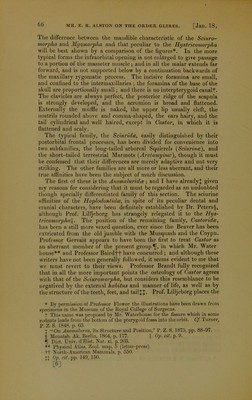
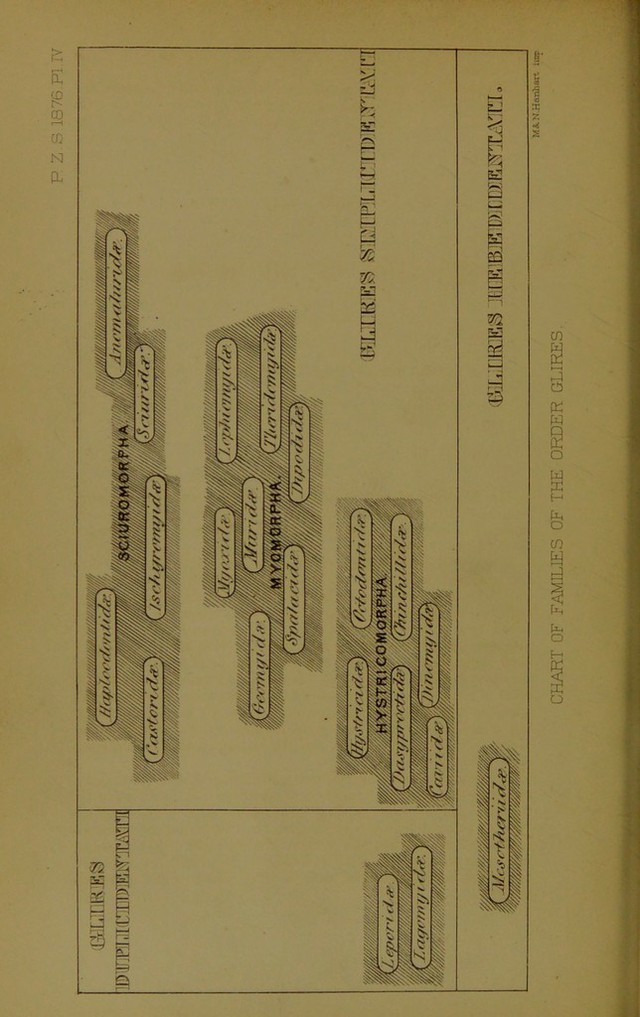
![Of the seven well-marked families into which this section may be divided, the typical one, the Muridce, comprises a great number of genera. The best classification of these with which I am acquainted is that of Dr. Peters, which is here adopted with some little modifi- cation, his groups being ranked as subfamilies, and a slight alteration being made in their arrangement*. M. A. Milne-Edwards having clearly proved that the genera Ellobius and Siphneus really belong to this familyf, the subfamily Siphneinae is now placed alongside of the Arvicolince, with which it is so nearly allied. Of the other families, the Myoxidce bear a very strong outward resemblance to the Sciuromorpha, which, however, is not mark- edly confirmed by their anatomy. Dr. Peters having shown that Platacanthomys must be removed to the MuridcE%, the remaining genera of Dormice are all very closely allied, and are isolated from all other known rodents by the complete absence of the caecum. The next family, Lophiomyidce, contains a single form differing in struc- ture not only from all the rest of the order, but even from all the known members'of the mammalian class§. Nevertheless, if the ex- traordinary development of the temporal and malar regions be over- looked, the whole skull of Lophioniys is truly murine in type ; and this is confirmed by all the other more important points in its anatomy. It is strange that, although its habits appear to be at least partly arboreal, Lophiomys should differ from all the rest of the section in the incomplete development of its clavicles. The Spalacidtf, even when disencumbered by the removal of Siphneus and JL'llobius, are still divisible into two subfamilies—the typical Spalacincc, which have the normal mandible of the section, and the Bathyergince, in which are found the hystricine characters already mentioned (supra p. 68), and which were hence named Spa- laces subhystriciformes by Prof. Brandt. The next family, which in- cludes the American rodents with cheek-pouches which open outside the mouth, was founded by Mr. Waterhouse under the name of Sacco- myidce, and subsequently divided by Prof. Baird into two subfamilies, Geomyince and Saccomyince. Dr. E. Coues, in a recent valuable memoir, has contended that these latter divisions should rank as separate though allied families||—a view in which I cannot agree. The diversity in their outward form may be paralleled by that in the Squirrels and Marmots ; and the differences in their cranial structure are, as Dr. Coues himself observes, of a superficial nature. In any case, Mr. Waterhouse’s name must be changed; for Dr. Peters has shown^f that the genus Saccomys of Frederic Cuvier is in all proba- bility, a synonym of Desmarest’s Heteromys. The oldest and best- * The names only of these divisions appeared in the Monatsb. Ak. Berlin, 1866, pp. 13, 14.; for access to Dr. Peters’s hitherto unpublished characters 1 am indebted to the courtesy of the author. t Recherches pour servir & l’Hist. Nat. des Mammiferes, pp. 71-129. t P. Z. S. 1865, pp. 397-399. § Cf. A. Milne-Edwards, Nouv. Arch, du Mus. iii. pp. 81-118. II Rep. Explor. Colorado River, p. 215; Bull. TT.S. Survey of Territories, 2nd ser. no. 2, pp. 81-90. ^ Monatsb. Ak. Berlin, .1874, p. 354-359. [9]](https://iiif.wellcomecollection.org/image/b22455334_0013.jp2/full/800%2C/0/default.jpg)