On the classification of the order Glires / by Edward R. Alston.
- Edward Richard Alston
- Date:
- 1876
Licence: Public Domain Mark
Credit: On the classification of the order Glires / by Edward R. Alston. Source: Wellcome Collection.
Provider: This material has been provided by The Royal College of Surgeons of England. The original may be consulted at The Royal College of Surgeons of England.
14/40 page 72
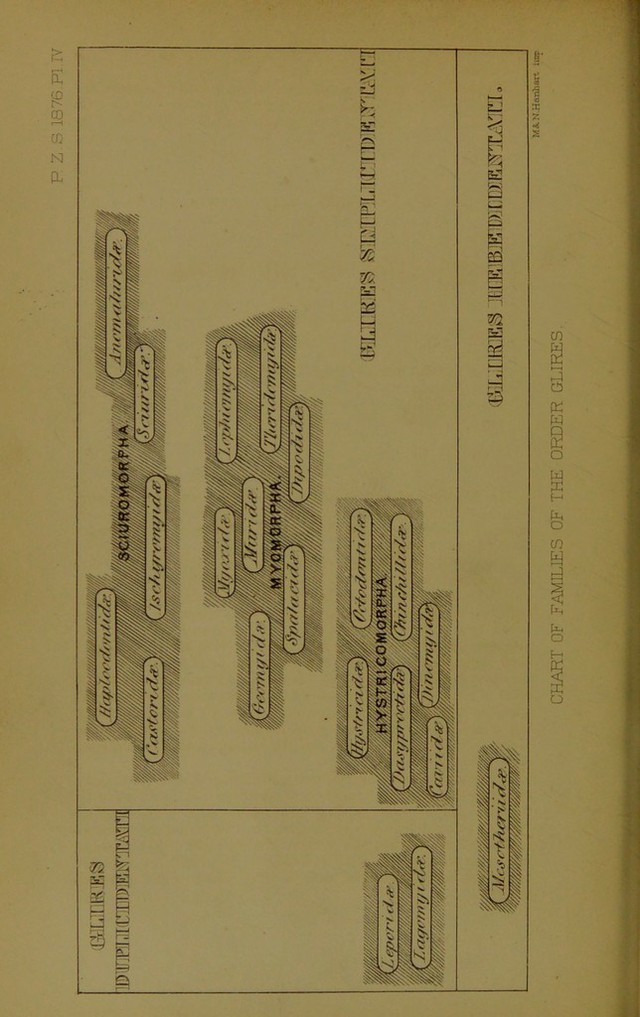
![nostrils pointed above, sigmoid or linear. The ears are very generally emarginate behind ; and the tail, when present, is cylindrical, hairy, scaly, or subnaked. In the division of the hystricine Rodents into families much diver- sity of opinion has prevailed. Mr. Waterhouse, laying too great stress on dental characters, entirely separated the Dasyproctina from the Caviina, and placed them between the Hystricina proper and the Echimyina*. Prof. Brandt reunited the two former in his family Hemionychoides, equivalent to the Subungulata of Illigerf. But the group thus formed is so ill defined that Prof. Lilljeborg found it im- possible to separate it from the Hystricidcei. It seems to me that, although Mr. Waterhouse was certainly misled in entirely separating the Agoutis and Pacas from the Cavies and Capybara, they must still be ranked as distinct but allied families, and that the same value must be given to the curious form named Dinomys by Dr. Peters§. Accordingly I would recognize six families of the ffystricomorpha. Of these the first, the Octodontidee, consists of three subfamilies ; for here, I think, must be placed the Ctenodactylince, formerly asso- ciated with the Jerboas, but of which the hystricine affinities have been established by Dr. Peters||. The other subfamilies are the Octo- dontince and Echinomyince of Mr. Waterhouse. Some of the genera of the latter make a close approach to the next family, the Ilystri- cidcc, which in its turn is composed of two very distinct subfamilies, Sphingurinee and IJystricincc; for I cannot follow Professor Lillje- borg in relegating the former to the Octodontulce^[, principally on account of their better-developed clavicles, which are probably an adaptive peculiarity connected with their arboreal habits. Of the remaining families the Chinchillidce form a small but very natural group, connected in some characters with the Dinomyidee; and the latter, again, has close affinities with the nearly allied Dasyproctidce and Caviidce. These latter families in many points, as in the mode in which their incisors wear down, their emarginated palates, and the large size of their basicranial foramina, show a striking ap- proach to the next great group of Rodents. The second suborder, Glires duplicidentati, containing only two families, is clearly less specialized than the first, and appears to be a survivor, representing a comparatively early stage in the develop- ment of the Rodent type. At birth, the upper jaw contains the normal number of incisors; but only the two inner pairs are refained; and of these the second remain very small, and are placed directly be- hind the large middle pair. In the mandible there is never more than one pair. Another important proof of the inferior degree of speciali- zation in the Glires duplicidentati is the fact that the enamel of the incisors may be traced round to tbeir posterior surface, though it is here much thinner than in front**. Of cranial characters, it may be * Nat. Hist. Mamm. ii. p. 360. t Prod. Syst. Maram.p. 92. | Op. cit. p. 54. £ Festschrift. Gesellsch. nat. Freunde, pp. 227-234 (1873). j| Tr. Z.S. vii. pp. 397-409. f Op. cit. p. 51. ** Cf. Owen, Comp. Anat. Yert. iii. p. 296. [12]](https://iiif.wellcomecollection.org/image/b22455334_0016.jp2/full/800%2C/0/default.jpg)