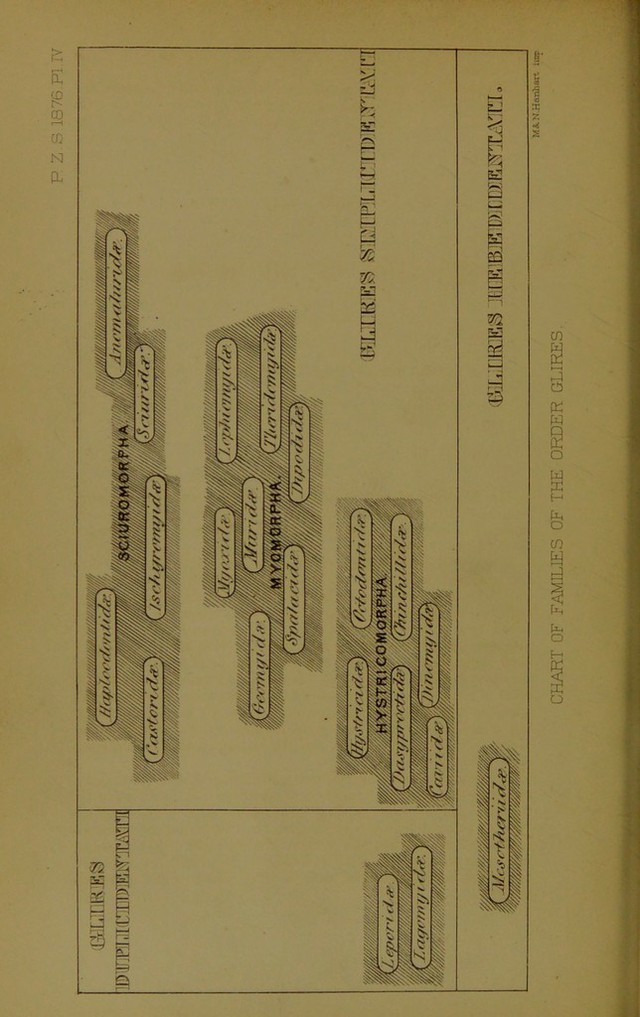
On the classification of the order Glires / by Edward R. Alston.
- Edward Richard Alston
- Date:
- 1876
Licence: Public Domain Mark
Credit: On the classification of the order Glires / by Edward R. Alston. Source: Wellcome Collection.
Provider: This material has been provided by The Royal College of Surgeons of England. The original may be consulted at The Royal College of Surgeons of England.
19/40 page 77
![2. Sciurus, Linnaeus, Syst. Nat. i. p. 86 (1766). Limbs free, form agile, tail long, bushy. No cbeek-pouches; three or four pairs of teats. First upper premolar sometimes soon lost. Frontals ankylosed with parietals ; postorbital processes moderate ; infraorbital opening in front of anterior root of zygoma. Palate broad, flat. 3. Xerus, Hemprich & Ehrenberg, Symbol. Phys., Mamm. i., gg (1832). Ears very short or rudimentary, tail short, fur sparse, harsh, with flattened spines. No cheek-pouches, two pairs of teats. Nasals and palate narrower, and postorbital processes much smaller than in Sciurus. 4. Tamias, Illiger, Prod. Syst. Mamm. p. 83 (1811). Ears short, fore feet with the fourth digit longest, limbs subequal, tail short. Large internal cheek-pouches. First upper premolar soon lost. Skull slender; infraorbital opening in anterior root of zygoma, not in front of it. B. Arctomyinal. Incisors not compressed. Limbs free, form usually stout, tail short. Palaearctic and Nearctic. Recent genera: — 5. Spermophilus, F. Cuvier, Mdm. du Mus. vi. p. 293 . (1822). Form somewhat slender; tail short or ‘moderate. Claw of pollex rudimentary or absent. Large cbeek-pouches. Series of grinding- teeth nearly parallel. Skull with no marked ridges; postorbital processes slender, directed backwards. 6. Cynomys, Rafiuesque, Amer. Monthly Mag. ii. p. 45 (1817). Form thickset, tail short, claws of fore feet long on all the digits, shallow cheek-pouches. Series of grinding-teeth strongly convergent behind. Skull short and broad ; postorbital processes long, directed backwards ; parietals narrow, parallelogrammatic. 7. Arctomys. Schreber, Saugethiere, iv. p. 721 (1792). Form thickset, tail short; pollex rudimentary, with a flat nail. Cheek-pouches rudimentary or absent. Series of grinding-teeth nearly parallel. Skull broad ; postorbital processes large, trian- gular, standing out at right angles ; parietals narrow, parallelogram- matic. Fossil genera. The following genera, characterized from details of dentition, seem to be referable to this family:—Plesarctomys, Bravard, in Gervais’s ‘ Zool. et Pal. Fra^.’ pi. xlvi. (1852), Eocene of France; Pseudosciurus, Hensel, Z. Deutsch. geol. Ges. 1856, p. 660, bone-beds of Wiirttemberg; Sciuravus, Marsh, Am. Journ. Sc. 1871, p. 120, Eocene of North America; Paramys, Leidy, Geol. Survey, Montana, 1871, p. 363 (perhaps the same as the last) ; Gym- notrichus, Cope, Pal. Bulletin, i. p. 6 (1874), Miocene of North America. [17]](https://iiif.wellcomecollection.org/image/b22455334_0021.jp2/full/800%2C/0/default.jpg)