On the classification of the order Glires / by Edward R. Alston.
- Edward Richard Alston
- Date:
- 1876
Licence: Public Domain Mark
Credit: On the classification of the order Glires / by Edward R. Alston. Source: Wellcome Collection.
Provider: This material has been provided by The Royal College of Surgeons of England. The original may be consulted at The Royal College of Surgeons of England.
20/40 page 78
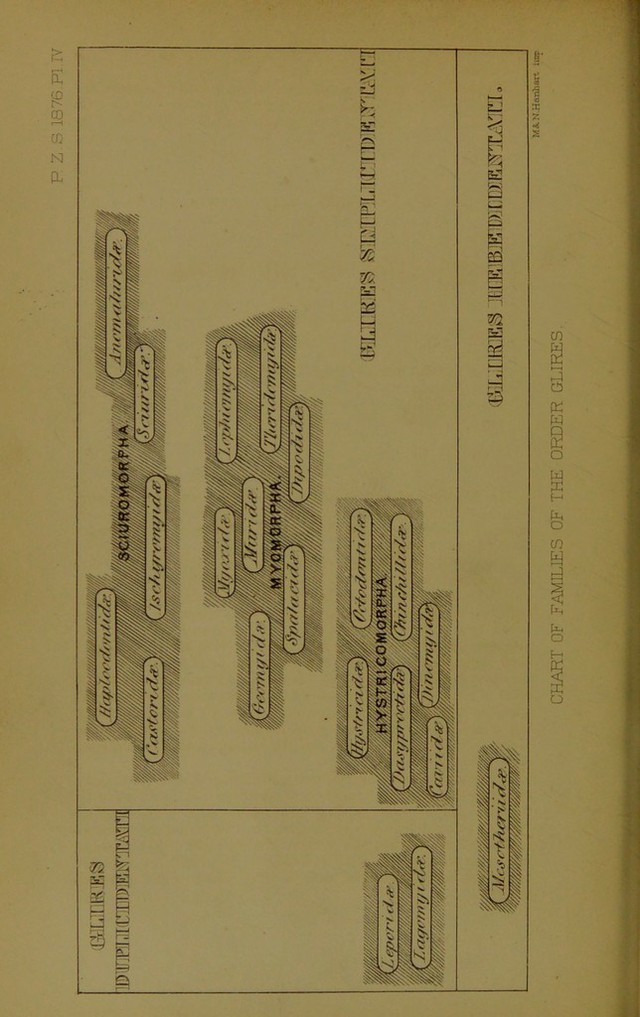
![Family III. Ischyromyid^e (fam. nov.)*. Dentition as in Sciuridee. Skull resembling Castoridce, but with the infraorbital opening large, a sagittal crest, no postorbital processes, palate broad, basioccipital keeled. Miocene of North America. Fossil genus :— Ischyromys, Leidy, Proc. Acad. Philad. 1856, p. 89 . . (1856). (Characters those of the family.) Family IV. Haplodontid^e. Two premolars above and one below, the first upper premolar small; grinding-teeth rootless, simple, and prismatic. Skull much depressed, no postorbital processes, infraorbital opening small, angular portion of mandible much twisted. Tail short, cylindrical, hairy. Nearctic. Recent genus:— Haplodon — Aplodontia, Richardson, Zool. Journ. iv. p. 334 (1829). (Characters those of the family.) Family V. Castoridce. One premolar above and below; grinding-teeth subequal, semi- rooted or rootless, with reentering enamel-folds. Skull massive, no postorbital processes, infraorbital opening small and placed low, a sagittal crest, angle of mandible rounded. Carpus with a large acces- sory ossicle. Stomach with a glandular appendage, excretory and generative organs opening into a common cloaca. Tail broad, flat- tened, spatulate and reticulated. Hind feet fully webbed. Pakearctic and Nearctic. Recent genus: — 1. Castor, Linnaeus, Syst. Nat. i. p. 78 (1766). (External characters those of the family.) Upper grinding-teeth subequal, each with oue internal and three external enamel-folds; the lower similar but reversed; the subsidiary folds not soon isolated from the exterior. Parietals narrow, parallelogrammatic; interparietal triangular; basioccipital concave. Fossil genera:— 2. Diobroticus, Pomel, Arch. Bibl. Univ. Geneve, ix. p. 167f. (1848). Skull much as in Castor. Third upper molar and lower premolar elongate, with four euamel folds, the rest with only twfo ; all the folds soon isolated. 3. Stenojiber, Is. Geoffroy, Revue Encyclopedique. . . . (1833). Parietals not parallelogrammatic ; interparietal subhexagonal; basi- occipital not concave. Grinding-teeth as in Castor, the subsidiary folds sooner isolated. * It seems probable that Pseudotomys, Cope, Proe. Am. Phil. Soc. 1872, p. 467, from Eocene of North America, may prove to belong to this family. f —Trogontherium Owen (nec Fischer), Brit. Foss. Mamm. p. 184; Geol. Mag. vi. pp. 49-56 (cf. Gervais, Zool. et Paleont. G6noralcs, pp. 80-84). [18]](https://iiif.wellcomecollection.org/image/b22455334_0022.jp2/full/800%2C/0/default.jpg)