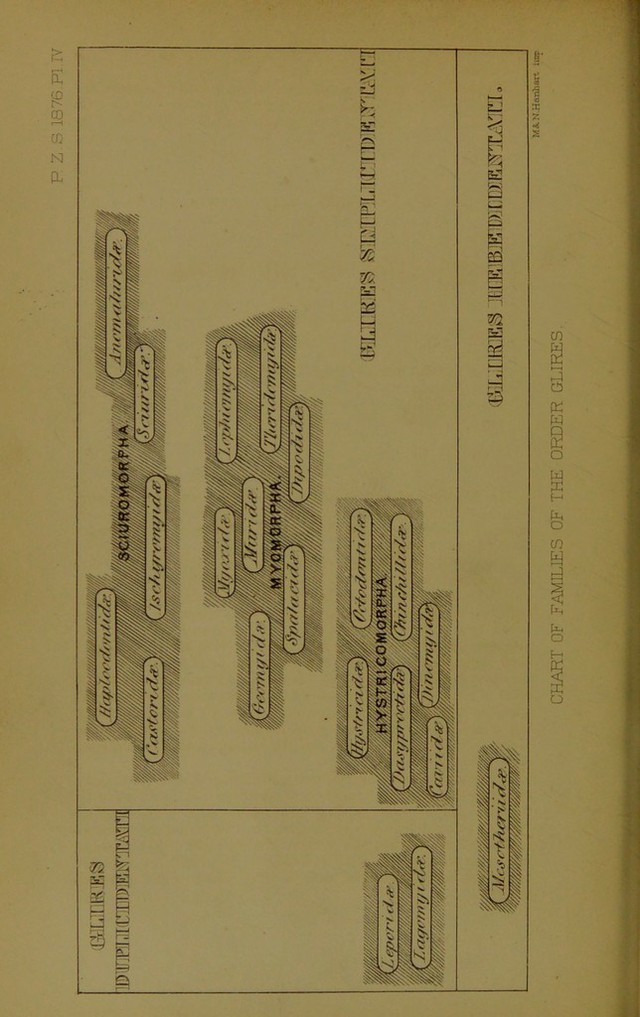
On the classification of the order Glires / by Edward R. Alston.
- Edward Richard Alston
- Date:
- 1876
Licence: Public Domain Mark
Credit: On the classification of the order Glires / by Edward R. Alston. Source: Wellcome Collection.
Provider: This material has been provided by The Royal College of Surgeons of England. The original may be consulted at The Royal College of Surgeons of England.
21/40 page 79
![4. Castoroides, J. W. Forster, 2nd Rep. Geol. Ohio, p. 81 (1838). Parietals not parallelogrammatic; interparietal very small; basi- occipital concave. Incisors with numerous longitudinal grooves ; grinding-teeth with the enamel-folds extending quite across their crowns, completely separated and united only by cement; the last upper molar and lower premolar with four folds, the rest with three only. More doubtful fossil genera are :—Trogontherium, Fischer, Mem. Soc. Imp. Nat. Mosc. ii. p. 260 (1809) ; Balceomys, Kaup, Isis, 1832, p. 992 ; Chalicomys, Kaup, op. cit. p. 994 ; Chelodus, Kaup, op. cit. p. 995; Palceocaster, Leidy, Journ. Ac. Philad. vii. p. 338 (1869). Section II. Myomorpha. Premolars present or absent ; grinding-teeth rooted or rootless. No postorbital frontal processes ; infraorbital opening various. Zygo- matic arch slender; the malar rarely extending far forward, and being usually supported below by a continuation of the maxillary zygomatic process. Incisive foramina usually long, and extending into the maxillaries. Outer walls of pterygoid fossse often obsolete, no inter- pterygoid fissure (except in Bathyergince). Angular portion of mandible springing from the lower edge of the bony covering of tbe lower incisor (except in Bathyergince). Clavicles perfect (except in Lophiomyidce). Tibia and fibula completely ankylosed in the adult for at least their lower third. Upper lip usually cleft; muffle small and naked; nostrils comma-shaped, rounded above. Tail cylindrical, either hairy or covered with scales arranged in rings. Seven families:— Family I. Myoxid,e. One premolar above and below, which is rather smaller than the molars ; all the grinding-teeth rooted, with transverse enamel-folds. Skull with frontals much contracted, clasped by the parietals ; inter- parietal broad, articulating with the squamosals. Infraorbital opening moderate, high, narrow. Mandible with the angle rounded or sub- quadrate, coronoid long and slender. No caecum. Form gracile; eyes and ears large ; fore limbs small; tail long, hairy. Palaearctic and Ethiopian. Recent genera :— 1. Myoxus, Schreber, Saugeth. iv. p. 824 (1792), Tail bushy and distichous throughout. Stomach simple. An- gular portion of mandible not perforate. Premolars small ; molars large, with well-marked enamel-folds. 2. Muscardinus, Kaup, Entw. europ. Thierw. p. 139 .. . (1829). Tail bushy and cylindrical throughout. Stomach complicated. Mandible not perforate. Grindiug-teeth large ; their crown flat, with well-marked and numerous folds. 3. Eliomys, Wagner, Abhand. baierisch. Akad. iii. p. 179 (1843). Tail with short hairs at base, tufted and distichous towards its [19]](https://iiif.wellcomecollection.org/image/b22455334_0023.jp2/full/800%2C/0/default.jpg)