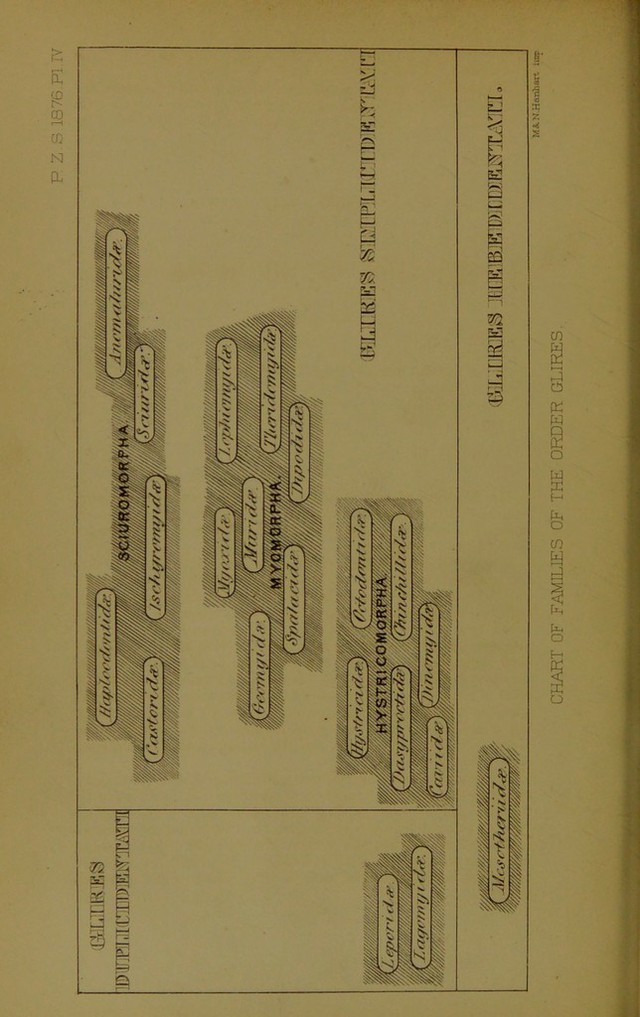
On the classification of the order Glires / by Edward R. Alston.
- Edward Richard Alston
- Date:
- 1876
Licence: Public Domain Mark
Credit: On the classification of the order Glires / by Edward R. Alston. Source: Wellcome Collection.
Provider: This material has been provided by The Royal College of Surgeons of England. The original may be consulted at The Royal College of Surgeons of England.
24/40 page 82
![9. Nesokia, Gray, Ann. and Mag. Nat. Hist. x. p. 264 . (1842). Muzzle blunt; ears moderate; claws long; fur rather harsh ; tail short, scaly, sparsely haired. Palate narrow ; incisive foramina short; auditory bullae rather small. Incisors broad. First molars with three laminae ; the rest with two only. F. Dendromyin^e. Incisors convex in front; molars tuberculate. Infraorbital opening not narrowed below; coronoid process very small. Ears hairy. Claws long. Ethiopian. Recent genera:— 10. Dendromys, A. Smith, S. African Q. Journ. ii. p. 158 (1834). Form slender; tail long, scaly, and sparsely haired. Three middle digits of each foot much longer than the first and fifth. Incisors grooved. Molars parallel in series ; the first as long as the second and third taken together; their tubercles arranged in pairs. 11. Steatomy8, Peters, Reise n. Mossambique, i. p. 162 . (1852). Form plump ; tail rather short, finely scaled and densely haired ; claws of fore feet the longest. Incisors grooved. Molars converging behind ; the first longer than the second and third taken together ; their tubercles arranged in twos and threes. 12. Lophuromys, Peters, Monatsb. Ak. Berlin, 1874, p. 234 (1874). Form as in Steatomys, but fur developed into fine flattened bristles, pterygoid fossae longer, and coronoid process better-developed. In- cisors plain. Molars nearly parallel in series ; the third upper with only two anterior tubercles. G. Cricetin.se. Molars tuberculate. Infraorbital opening sub- typical, not much narrowed helow, and the perpendicular plate little developed. Large internal cheek-pouches. Palaearctic and Ethiopian. Recent genera:— 13. Cricetus, G. Cuvier, Regne Animal (lre ed.), i. p. 198 (1817). Form thickset; limbs short; claws large ; tail short, not scaly, sparsely haired. Cheek-pouches large. Skull with marked but rounded supraorbital ridges continued into temporal ridges ; coronoid process high and falcate. Incisors plain. Molars with tubercles arranged in pairs, of which the first has three and the rest two only ; these entirely disappear in aged specimens. 14. Saccostomus, Peters, Monatsb. Ak.Berl. 1846, p. 258 (1846). Form as in Cricetus, but feet and claws weaker and more murine. Cheek-pouches moderate. Supraorbital ridges more parallel, and infraorbital opening more typically murine ; incisive foramina longer. Incisors plain. Molars with tubercles arranged in threes, one of each row being smaller than the other two. 15. Cricetomys, Waterhouse, P. Z. S. 1840, p. 2 . . . . (1840). Form more murine; muzzle pointed ; tail long, scaly, and very [22]](https://iiif.wellcomecollection.org/image/b22455334_0026.jp2/full/800%2C/0/default.jpg)